"who does the wolf love?"
posted by k
In my brief and ineffectual period of political involvement – back in the 1970s - I learnt some of the rules about elections. I saw how counts were conducted and scrutinised, I discovered that there were limits on party spending in any constituency – and that they started the moment a candidate stopped being called the “prospective party candidate” after his official adoption for the seat, and I learnt the rules on treating.
“Treating” is regarded in electoral law as a form of bribing the electorate. I learnt that the rules were so strict that if I was working in a committee room on election day, I'd have to pay for any coffee and biscuits I consumed, even though the committee room was in the house of a personal friend. If I didn't pay for my mid-morning snack, that could either be regarded as a bribe to vote for the candidate I supported or as payment for my services, in which case it could topple the allowed expenses for the constituency over the permitted maximum.
Things seem to have changed, according to Craig Murray's account of Jack Straw's campaign in Blackburn. Jack Straw, the Secretary of State for Justice, seems happy to invite 700 people for free, sit-down dinners. It sounds like the sort of practice that led to laws against treating. He's been getting away with it for years so, unless the rules have changed, I suppose he's found some way round the law. I wonder what it is.
All politicians offer bribes to voters. The party manifestos are full of them. There are promises to help you if you're poor, rich, old, young, married, officially partnered. There are even bribes for the dead – the Conservative Party's rhetoric talks of a “death tax,” as though people would rather pay more in taxes when still alive. (Nobody seems to have noticed the way the conservatives' proposed marriage allowance deprives the widows and abandoned, whose taxes will rise by £150 a year, as if to punish them for the loss of a partner.)
There's something disturbing about this focus on bribing the electorate. Media stories repeatedly tell voters that it's fine – even praiseworthy – to vote entirely out of self-interest. Self-interest is bound to play a part. I know the world most vividly from my own experience and that is bound to influence my decisions. But there's more to it than that. As citizens in a democracy, we should also be asked to consider the good of the whole. I want to vote for more than “bread and circuses.”
There's nothing indecent in caring for the well-being of others – even people I haven't met. Most people are more generous and unselfish than they realise. If I look around, I see daily acts of kindness and courtesy – cruelty and selfishness are still unusual enough to be shocking. People who can barely afford it give money to charitable appeals. Marathon runners ask for sponsorship – often to help people they don't know – and their friends are happy to sponsor them. People who express hatred or mistrust for a minority group (Muslims, asylum seekers, gay people) rarely live out that hatred in their daily lives but make ever more exceptions for the likeable individuals they encounter.
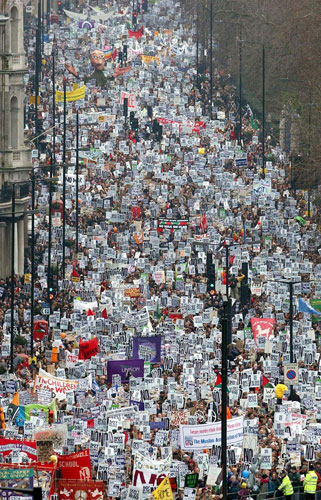 Away from elections, citizens also care about big political questions and international responsibility. At the lowest estimate, 1 in 50 members of the entire British population made their way to one of the big anti-war demonstrations on 15th February, 2003. They were supported by millions more. This wasn't a selfish impulse but a real political concern which the government chose to attack, misrepresent and finally ignore. Huge numbers of people are concerned about poverty overseas and pollution of the environment. Beside the concerns of the people, the scope of the leaders' debates and media reporting seems rather narrow, as though voters are being encouraged to vote only from self-interest.
Even if we were all to vote from self-interest, we don't have the information we need. The three candidates for chancellor agreed in their debate that cuts would be brutal – harsher than under Thatcher – but none of the leaders is prepared to turn to the voters and explain precisely what they plan for us. The Financial Times on 26th April laid out the kind of cuts we might expect; according to their simulator, using government figures, cuts of £30 – 40 billion, which all parties agree we need, would require the following cuts or their equivalent:
" a 5 per cent cut in public sector pay; freezing benefits for a year; means-testing child benefit; abolishing winter fuel payments and free television licences; reducing prison numbers by a quarter; axing the two planned aircraft carriers; withdrawing free bus passes for pensioners; delaying Crossrail for three years; halving roads maintenance; stopping school building; halving the spending on teaching assistants and NHS dentistry; and cutting funding to Scotland and Wales by 10 per cent."

None of the parties is talking about cuts on this scale – and no-one seems to be addressing the knock-on effect such cuts would have. If large groups of people have less money to spend, a large number of businesses will collapse – and that will lead to more unemployment and, presumably, higher spending on benefits. It's a nasty cycle and no-one is talking about how we shall ever get out of it – or whether we need to adjust our way of life.
This election should have been an opportunity to discuss questions of equality and the distribution of wealth. These are vital questions in a democracy. Wealth buys influence – and that may be the strongest political argument for its more equal distribution. There are also important ways in which the poor are not free.
During this election, the media have encouraged us to see the political parties as purveyors of treats and promises. What they offer sounds more alluring than a cup of instant coffee and a biscuit – or even a plate of curry. But the rewards we're offered may prove insubstantial – and they're a pretty poor substitute for a grown-up and thoughtful political debate.

In my brief and ineffectual period of political involvement – back in the 1970s - I learnt some of the rules about elections. I saw how counts were conducted and scrutinised, I discovered that there were limits on party spending in any constituency – and that they started the moment a candidate stopped being called the “prospective party candidate” after his official adoption for the seat, and I learnt the rules on treating.
“Treating” is regarded in electoral law as a form of bribing the electorate. I learnt that the rules were so strict that if I was working in a committee room on election day, I'd have to pay for any coffee and biscuits I consumed, even though the committee room was in the house of a personal friend. If I didn't pay for my mid-morning snack, that could either be regarded as a bribe to vote for the candidate I supported or as payment for my services, in which case it could topple the allowed expenses for the constituency over the permitted maximum.
Things seem to have changed, according to Craig Murray's account of Jack Straw's campaign in Blackburn. Jack Straw, the Secretary of State for Justice, seems happy to invite 700 people for free, sit-down dinners. It sounds like the sort of practice that led to laws against treating. He's been getting away with it for years so, unless the rules have changed, I suppose he's found some way round the law. I wonder what it is.
All politicians offer bribes to voters.
The party manifestos are full of them. There are promises to help you if you're poor, rich, old, young, married, officially partnered. There are even bribes for the dead – the Conservative Party's rhetoric talks of a “death tax,” as though people would rather pay more in taxes when still alive. (Nobody seems to have noticed the way the conservatives' proposed marriage allowance deprives the widows and abandoned, whose taxes will rise by £150 a year, as if to punish them for the loss of a partner.)There's something disturbing about this focus on bribing the electorate. Media stories repeatedly tell voters that it's fine – even praiseworthy – to vote entirely out of self-interest. Self-interest is bound to play a part. I know the world most vividly from my own experience and that is bound to influence my decisions. But there's more to it than that. As citizens in a democracy, we should also be asked to consider the good of the whole. I want to vote for more than “bread and circuses.”
There's nothing indecent in caring for the well-being of others – even people I haven't met. Most people are more generous and unselfish than they realise. If I look around, I see daily acts of kindness and courtesy – cruelty and selfishness are still unusual enough to be shocking. People who can barely afford it give money to charitable appeals. Marathon runners ask for sponsorship – often to help people they don't know – and their friends are happy to sponsor them. People who express hatred or mistrust for a minority group (Muslims, asylum seekers, gay people) rarely live out that hatred in their daily lives but make ever more exceptions for the likeable individuals they encounter.
Away from elections, citizens also care about big political questions and international responsibility. At the lowest estimate, 1 in 50 members of the entire British population made their way to one of the big anti-war demonstrations on 15th February, 2003. They were supported by millions more. This wasn't a selfish impulse but a real political concern which the government chose to attack, misrepresent and finally ignore. Huge numbers of people are concerned about poverty overseas and pollution of the environment. Beside the concerns of the people, the scope of the leaders' debates and media reporting seems rather narrow, as though voters are being encouraged to vote only from self-interest.Even if we were all to vote from self-interest, we don't have the information we need. The three candidates for chancellor agreed in their debate that cuts would be brutal – harsher than under Thatcher – but none of the leaders is prepared to turn to the voters and explain precisely what they plan for us. The Financial Times on 26th April laid out the kind of cuts we might expect; according to their simulator, using government figures, cuts of £30 – 40 billion, which all parties agree we need, would require the following cuts or their equivalent:
" a 5 per cent cut in public sector pay; freezing benefits for a year; means-testing child benefit; abolishing winter fuel payments and free television licences; reducing prison numbers by a quarter; axing the two planned aircraft carriers; withdrawing free bus passes for pensioners; delaying Crossrail for three years; halving roads maintenance; stopping school building; halving the spending on teaching assistants and NHS dentistry; and cutting funding to Scotland and Wales by 10 per cent."

None of the parties is talking about cuts on this scale – and no-one seems to be addressing the knock-on effect such cuts would have. If large groups of people have less money to spend, a large number of businesses will collapse – and that will lead to more unemployment and, presumably, higher spending on benefits. It's a nasty cycle and no-one is talking about how we shall ever get out of it – or whether we need to adjust our way of life.
This election should have been an opportunity to discuss questions of equality and the distribution of wealth. These are vital questions in a democracy. Wealth buys influence – and that may be the strongest political argument for its more equal distribution. There are also important ways in which the poor are not free.
During this election, the media have encouraged us to see the political parties as purveyors of treats and promises. What they offer sounds more alluring than a cup of instant coffee and a biscuit – or even a plate of curry. But the rewards we're offered may prove insubstantial – and they're a pretty poor substitute for a grown-up and thoughtful political debate.
Labels: altruism, bribery, Craig Murray, cuts, debate, demonstration, economics, election, equality, freedom, self-interest, treating, war
posted by areopagitica at 9:23 am
1 comments