Saturday, May 01, 2010

"He loved Big Brother now."

posted by k

I'm waiting for the knock on the door.


My largely law-abiding life won't save me. They've invented new laws and then, just in case they've missed something, there are ways of personalising the law – devising special laws to get just one person. And I'm not talking about Brian Haw, who got the honour of a special clause in an act of parliament (which turned out not to work in his case after all). I'm talking about laws which might get me – or you. It wasn't always quite so bad.

Of course, there have been plenty of laws to trap the unwitting or foolish or honest. Don't tell a soldier you think he or she should have a change of career. That breaks the Incitement to Disaffection Act (1934). (I've broken that one a couple of times. I'd rather they arrested me for that because I did it deliberately - I think it's wrong to deprive anyone of freedom of thought and conscience.) And there are bad laws which have been repealed. Section 28, which scared teachers out of saying that Oscar Wilde was gay or that most of Shakespeare's sonnets were written to a fair young man, is no longer on the statute books. I'm pleased about that.
But there are all those new, apparently well-meaning laws which seem to be used in unpredicted ways.

Take the law on stalking. One individual stalking another is a nasty, threatening matter. I've known young women in particular – though it's not only young women who are affected – really frightened by phone-calls in the middle of the night, threatening letters, displays of covertly-taken photographs. When victims complain and nothing is done, I'm angry. When victims, who may have been stalked for years, are beaten up and even killed, I start asking, “Why didn't they listen to her? Why don't they do something?”
So the government responded. A minister could have pointed out that there were already laws against harassment or proposed a slight adjustment to existing laws. Instead we were offered a brand-new, shiny law which would protect the vulnerable from harm – and even from mild distress.

But it wasn't just used against stalkers. It was one of those all-purpose, catch-all laws which could be used against anybody who talked to or wrote to someone more than once. If I encounter an arms manufacturer on the train – it could happen; making weapons is big business in Britain – and find out about his profession, I might express myself strongly, even enter into an argument with him. And if I see him the next day, I might continue that argument – and he might be annoyed. Under the law, that would count as stalking and I might find myself in jail. If I were handing out leaflets and offered one to the same person twice, that might be considered a crime. It seems to me that if a friend and I had a row in a pub and one of us phoned the other to continue the row, that might be considered stalking.

The law is being framed to prevent awkward behaviour and mild distress – and the government seems quite pleased that it sweeps up political protesters and non-violent dissidents as well.
Bu you don't have to break the law to get an ASBO. Anti-social behaviour legislation has been so widely framed that it's possible to construct a special law to limit the freedom of speech, action and movement of one individual who hasn't broken any law. That idea was controversial when it came in but now everyone's used to the idea that if your neighbour annoys you enough, you might be able to stop the annoyance with an ASBO. Sometimes ASBOs are used instead of charging someone with a more conventional crime. ASBOs allow magistrates to impose sentences that they make up: people can be banned from places and forbidden to act in a way that is perfectly legal for anybody else.

ASBOs lack the legal safeguards of conventional criminal laws and injunctions which protect individuals. If you break an ASBO – a law constructed just for you – you can land in jail. It's another convenient tool for dealing with protesters and dissidents.


Freedom of speech is being eroded too. I'm not an absolutist about freedom of speech. I'm not in favour of inciting hatred against anyone. Incitement to violence is dangerous. (I sometimes wonder why politicians are never charged with either offence.) There are many individuals and groups who suffer because of what is said about them – that's important for everyone to remember. Politicians and the people have a responsibility to counter a climate of hate. Silence won't achieve that. Nor will the competitive xenophobia of politicians.

Of course I'm sometimes hurt and offended by people's attitudes and what they say. I'm human. But my first action isn't to ring the police. I can see why an airport chaplain was offended by anti-religious cartoons, clipped from Private Eye, left in the airport chaplaincy – they were probably left there to offend. Leaving them there might have been a silly action but it surely doesn't deserve a criminal record. The church wasn't damaged. God wasn't damaged. It seems particularly ludicrous in a nominally Christian country where – archaically – bishops vote as unelected members of the second chamber of parliament and the Archbishop of Canterbury plays a key role in the coronation of the monarch. And – oh -dear! - I've made tactless and ill-judged jokes at times. Will the police come round to get me?

With any luck, the police won't kill me, though since the death of Juan Charles Menenez and the case of David Mery I've felt a little less confident on the tube. I usually find the police polite, even though I was caught in a kettle once and found my experience rather different from the police's official account.

But what would happen if the police came round and arrested me? According to the the Proceeds of Crime Act 2002, the police keep 25% of the goods and money they confiscate and the Crown Prosecution Service keeps a further 25%. The law was meant – so were told – to deal with major criminals and drug traffickers using threats and violence – and the standard of proof of how the money was obtained was changed, so that the “criminal” had to prove a legal right to the money. It sounds great when dealing with international criminals. It's more troubling when the police seize the jewellery – and even the life savings – of prostitutes working together for their own protection. Prostitutes are not .likely to go to court to recover their money, as the law requires. So cash-strapped police forces find that pursuing a particular crime is a nice little earner for the force, so long as the police forget that they are now living on immoral earnings – the usual definition of a pimp.


I could go one. I could go on. There are so many liberties trickling away. I've committed so many offences that might be arrestable. I even took a photo of the House of Commons – with a policeman outside. Governments don't usual restore the liberties they have taken – unless the people insist. And all around me are people who have forgotten the liberties they lost and adjusted oppressive, intrusive laws. I'm adjusting too. This time next year, I may have forgotten what liberty is. What liberties have I forgotten already?


Labels: , , , , , , , , , , , , , ,

Monday, April 20, 2009

The Lost Principles of Policing

The Nine Principles of Policing were written in 1829, expanding on Sir Robert Peel's original Nine Points of Policing. Copies were issued to all members of the Metropolitan Police. There is some uncertainty about authorship. What is certain is that over the last 180 years, the themes which lie behind these philosophical guidelines have been forgotten.

The Nine Principles of Policing:

1. To prevent crime and disorder, as an alternative to their repression by military force and severity of legal punishment.

2. To recognise always that the power of the police to fulfil their functions and duties is dependent on public approval of their existence, actions and behaviour and on their ability to secure and maintain public respect.

3. To recognise always that to secure and maintain the respect and approval of the public means also the securing of the willing co-operation of the public in the task of securing observance of laws.

4. To recognise always that the extent to which the co-operation of the public can be secured diminishes proportionately the necessity of the use of physical force and compulsion for achieving police objectives.

5. To seek and preserve public favour, not by pandering to public opinion; but by constantly demonstrating absolutely impartial service to law, in complete independence of policy, and without regard to the justice or injustice of the substance of individual laws, by ready offering of individual service and friendship to all members of the public without regard to their wealth or social standing, by ready exercise of courtesy and friendly good humour; and by ready offering of individual sacrifice in protecting and preserving life.

6. To use physical force only when the exercise of persuasion, advice and warning is found to be insufficient to obtain public co-operation to an extent necessary to secure observance of law or to restore order, and to use only the minimum degree of physical force which is necessary on any particular occasion for achieving a police objective.

7. To maintain at all times a relationship with the public that gives reality to the historic tradition that the police are the public and that the public are the police, the police being only members of the public who are paid to give full time attention to duties which are incumbent on every citizen in the interests of community welfare and existence.

8. To recognise always the need for strict adherence to police-executive functions, and to refrain from even seeming to usurp the powers of the judiciary of avenging individuals or the State, and of authoritatively judging guilt and punishing the guilty.

9. To recognise always that the test of police efficiency is the absence of crime and disorder, and not the visible evidence of police action in dealing with them.

Dodo

Labels: , , , , , ,

Saturday, September 13, 2008

"A law indifferent to blame or praise"


posted by k


The year was 1670. Twelve jurors swore an oath to try William Penn and William Mead on the charges of addressing an unlawful assembly. On the bench, conducting the case and preparing the sentence, was Sam Starling, Lord Mayor of London, sitting with aldermen, Sherifs and a Recorder.

The case got off to a bad start when Penn and Mead, in accordance with Quaker practice, refused to take off their hats in court. The question of "hat honour" was thought important by Quakers as the time. They saw it as a way in which undue honour was given to certain individuals because of their wealth, birth or position. There were arguments over evidence and the law - the magistrates were particularly annoyed that William Penn cited statute law in his defence while William Mead demonstrated a knowledge of legal Latin. The case proceeded in a bad-tempered way until the jury, who had heard all the evidence, came back to deliver their verdict. And that's when the trouble began.

Initially there was disagreement between the jurors: eight agreed with one another and four dissented. The magistrates blamed this on a particular juror, Mr Bushel, who they threatened with violence. They sent the jurors out again and eventually they returned to deliver their verdict.

The jurors agreed that William Penn was guilty of speaking in Gracechurch Street but refused to add that the meeting was an unlawful assembly. They found William Mead not guilty.

The mayor and his fellow magistrates were furious. The mayor turned on the foreman of the jury. "I thought you had understood your place better," he said. Then the Recorder turned to the jurymen: "Gentlemen, you shall not be dismissed till we have a verdict that the court will accept; and you shall be locked up, without meat, drink, fire, and tobacco; you shall not think thus to abuse to court; we will have a verdict, by the help of God, or you shall starve for it."

The jury returned the following morning and repeated their verdict. The magistrates refused to accept it.

And so it went on, with the magistrates threatening all kinds of punishment and the jurors refusing to give in. The Recorder even threatened the jurors with that a new law would be made to deprive them of legal protection.

Finally the jurors changed their verdict; they found both William Penn and William Mead not guilty. The magistrates immediately imposed fines on Penn, Mead and all the jurors for contempt of court. On appeal, the jurors were freed under Habeas Corpus, setting a precedent which still protects those who sit on juries.

Today juries and jury trials are under further threat. The British government has already moved many cases from jury trials to magistrates courts. Now it is moving away from trials alogether and preferring detention without trial and summary "justice". On-the-spot fines are cheaper and less time-consuming than law and justice. The right to administer summary "justice" has even been sold to private companies, whose staff can be accredited on payment of a fee. At least the child and adult informers, bribed with rewards of up to £500 to spy and give evidence against their neighbours, aren't yet allowed to act as judge and jury in the cases.

Some cases still reach juries. However in the past week newspaper reporters and bloggers have fulminated against jurors for reaching an unexpected verdict in two cases. In the case of the would-be terrorists and alleged terrorists tried at the old Bailey, "sources close to the case" informed the press that the jury had behaved badly and the judge had conducted the case wrongly. The verdicts, which the jury returned after hearing five months' worth of evidence, were rubbished in a couple of paragraphs by people who hadn't heard the case or considered its strength.

Perhaps most worrying were the attacks on the jurors for taking time off for illness and medical appointments - and on the judge for allowing this. There is bound to be illness in any group of twelve people during a five month period and of course the case was held up when this happened - all the jurors must hear all the evidence. Had the jurors found the defendants guilty on all counts, I don't believe anyone would have made a fuss.

I was depressed too by blogs attacking the verdict in the case of the environmental activists at Kingsnorth, who were acquitted of causing crimninal justice. The defendants used the defence of "lawful excuse", arguing that climate change presented an urgent threat to people elsewhere in the world. One of their witnesses was an Inuit. The jurors were directed by the judge about the circumstances in which "lawful excuse" applied as a defence. They accepted the activists' argument that their action responded to an immediate need to protect the property of others.

I don't know all the scientific arguments about climate change but the defence of "lawful excuse" has a long history. I can see circumstances in which I too might break the law to protect other people and be glad of that defence. And I believe that the jurors who heard the case had a right to come to that verdict.

What would we do without trial by juries? "Trust the judges," some say. But judges are government appointees, dependent on the state for pay and promotion. While I'm sure that most judges act ethically, giving judges the power to reach a verdict lays them more open to threats and manipulation. The jurors force the lawyers to explain cases fully and clearly, so that each stage of the case and the law is explained publicly. They make the law and the evidence clear. The jury stand for the citizens of their country and have an obligation to justice.

When a jury stands out against public opinion or government, after hearing the evidence and the law, we should respect them and be grateful for their work.

At least one columnist has seen this and defended jurors against the rest of the press. When I read attacks on jurors in the press and the blogosphere, I can do no better than return to William Penn's words in 1670:

"It is intolerable that my jury should be thus menaced: Is this according to the fundamental laws? Are not they my proper judges by the great Charter of England? What hope is there of ever having justice done, when juries are threatened, and their verdicts rejected?"

Back in 1670 many people thought that a public Quaker Meeting was a source of danger. Today a marble plaque in the Central Criminal Court (the Old Bailey) commemorates the twelve jurymen who acquitted William Penn and William Mead.


Labels: , , , , , , , ,

Wednesday, November 21, 2007

Jahongir Sidikov - updates

posted by k

22.11.07

Jahongir Sidikov is being detained at Heathrow. He refused to board the plane (using passive resistance). This means it is still worth e-mailing MPs, registering protests, etc. See below for the reference numbers. Check Craig Murray's blog for further updates.

No-one should be deported to Uzbekistan until Amnesty International and Human Rights Watch say the country respects the rights of dissidents and citizens.

posted by k


Some Bloggers and others supporting Jahongir

Turbulent Cleric
Postman Patel
Beeston Quakers
kllrchrd
Obsolete
Kathz's Blog
Question That
Crimes and Corruption of the New World Order
My Whine in Silence
Signs of the Times
Politics in the Zeros
Bloggerheads
Chris Floyd telegrams
Indymedia UK
Rochdale online
Chris: Paul: Labour of Love
Craig Murray's Blog


21.11.07

The deportation is scheduled for tonight. Craig Murray gives the following updated information at his blog:

November 21, 2007

Save Jahongir Sidikov

I have just spoken to Jahongir who is expecting to be deported this evening, so we still have a few hours to try to stop this. An article 39 application to the European Court of Human Rights is being worked on, but not safe at this short notice. Meantime please contact your MP, any media contacts you have, anyone who might help. Both Tom Porteous of Human Rights Watch and myself worked the media yesterday, but to little apparent effect.

One of the many gross aspects of this case is that Jahongir's case has been "fast tracked" and gone through hearing and appeal to deportation in just a fortnight. His solicitor had less than a week to prepare his appeal - and unfortunately I was in Africa all that week and could not appear as a witness. The judge dismissed requests for a postponement on the grounds she could see no valid reason why witnesses could not get to court. She also dismissed a letter from Uzbek opposition leader Mohammed Salih as not genuine - even though I know for sure it was genuine. This case points up the farce of our asylum system and the cruelty of the "Fast Track" process.

These are Jahongir's Home Office references:
Home Office ref. – S2185191
Port ref. – BGT/188094
DMS ref. – 67823

Jahongir is currently in Harmondsworth Detention Centre.

Jahongir's deportation is, beyond any possible dispute, illegal under international law. The UK is a State Party to the UN Convention Against Torture, which states at Article 3:

Article 3 1. No State Party shall expel, return ("refouler") or extradite a person to another State where there are substantial grounds for believing that he would be in danger of being subjected to torture.

2. For the purpose of determining whether there are such grounds, the competent authorities shall take into account all relevant considerations including, where applicable, the existence in the State concerned of a consistent pattern of gross, flagrant or mass violations of human rights.


it is quite impossible to argue, by the standard given, that it is admissible to return Jahongir to Uzbekistan. As a nation we appear to have abandoned all pretence at legality.
http://www.ohchr.org/english/law/cat.htm


If there is anything you can do to help - however little - please act.

Labels: , , , , , , ,

Monday, October 08, 2007

"a bloodthirsty and unconstitutional force"

posted by k
(with apologies for double-posting)

Accusations flew. Counter-accusations parodied the voice of authority. It was It was 1839.

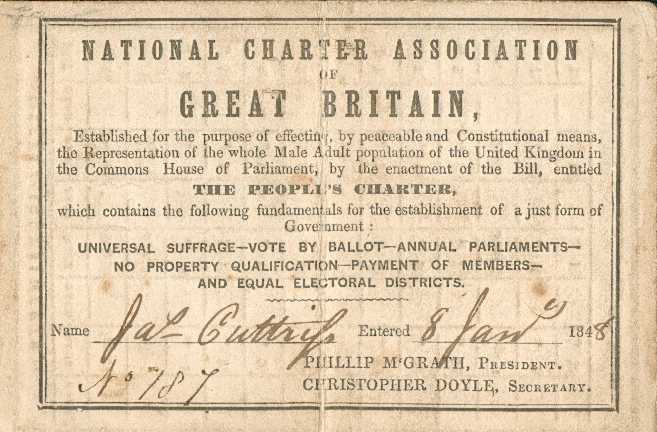
Memories of the Peterloo Massacre and authorised brutality were strong. But the Chartists were determined on reform. The ideas came from working-class people and their demands were simple.

The Charter had six points:

1. annual general elections
2. universal manhood suffrage
3. secret ballot
4. abolition of property qualifications of MPs
5. payment of MPs
6. equal electoral districts and redistribution of seats

These demands don't seem very radical today. We don't have annual parliaments but the question of fixed-term parliaments is being discussion again. All other points are taken for granted. In 1839 the Chartists were treated as dangerous revolutionaries.

On 4th July police were brought from London to break up a demonstration in the Birmingham Bull Ring. Placards produced by the Chartist convention described the Metropolitan police as "a bloodthirsty and unconstitutional force." William Lovett, the peaceable secretary of the convention, was later tried with the man who took the placards to the printer. Lovett was sentenced to a year's imprisonment for seditious libel.


The first Chartist petition was three miles long with 11 million signatures (including some forgeries). On 12th July it was presented to parliament by Thomas Atwood MP. Benjamin Disraeli was among the MPs voting to debate the petition. But MPs decided, by a majority of 235 to 46, that they wouldn't consider it. So there was no debate on its provisions before the petition was rejected.

There were always some Chartists in favour of physical force, if moral arguments failed. After the rejection of debate on the petition, a series of risings took place. The Newport Rising on 4th November attempted to free political prisoners from the Newport's Westgate Hotel. About 20 Chartists were killed. Three leaders of the rising were found guilty of high treason and sentenced to be hung, drawn and quartered. The sentences were later commuted to transportation for life.

In this atmosphere of fear and repression the government passed the 1839 Metropolitan Police Act. It's a wide-ranging law, rather like the Serious Organised Crime and Police Act of 2005 - the act which bans everybody except Brian Haw from unlicensed demonstrations, placard-holding and badge-wearing in central London. The 1839 Metropolitan Police Act includes stop and search provisions, laws against "furious driving" (of carts), provisions against causing annoyance by kite-flying or ringing doorbells, a ban on blowing horns and lots of provisions against bad language. It also includes a sessional order to ensure that MPs can reach parliament without being obstructed.

This is the law which the government is using the ban the anti-war demonstration today. I wonder what the police will do about David Howarth MP, who plans to join the protest. Perhaps they'll arrest him for attempting to obstruct himself. This would be a shame because he's due to table a Bill which comes close to the one aim of the Chartists that has not yet been accomplished: fixed-term parliaments.


There are uncomfortable echoes of those repressive days in which Chartists were jailed and sentenced to death. However, it's good to see that I can now find Craig Murray's blog in its familiar form by typing the url www.craigmurray.org.uk . It still doesn't take comments and there are no new posts. But I look forward to reading Craig Murray again.


STOP PRESS: Permission was finally given for the march less than an hour before it was due to begin. The government changed its mind in February 2003 as well. In 2003 they gave a little more notice.


Labels: , , , , , ,

Sunday, September 30, 2007

"poor indeed"

posted by k

" Good name in man and woman, dear my lord,

Is the immediate jewel of their souls:
Who steals my purse steals trash; 'tis something, nothing;
'Twas mine, 'tis his, and has been slave to thousands:
But he that filches from me my good name
Robs me of that which not enriches him
And makes me poor indeed."

I've seen those words quoted with approval on a number of websites. They even appear in the Harvard Gazette as an example of the value poets like Shakespeare place on an individual's reputation. But the websites rarely mention which character in Othello speaks those words. It's Iago, the villain of the play, and he uses his praise of reputation to further the plot which will end in the deaths of Othello, Desdemona and his own wife.

The law of libel does protect reputation. But the case of Craig Murray, whose blog was silenced by Uzbek billionaire Alisher Usmanov, raises questions about how this is done, who benefits and what truths are being silenced.

Of course, there is some value in libel laws. For instance, a candidate for a job or for public office shoud not be able to spread lies about another candidate. Nor should journalists be able to ruin the reputations, careers and personal happiness of footballers, pop singers or politicians by printing lies about them. I haven't been too worried about people in the public gaze moving to protect themselves from press intrusion. I don't see why I have the right to know about a sportsman's legal sexual preferences or behaviour on the spurious grounds that athletic brilliance turns its possessor into a role model.

But what about truths that need to be told? The Usmanov story - not mentioned in the press - concerns activities in other countries where Usmanov is protected by the regimes. If Usmanov really is, as alleged, a thug, criminal, racketeer and heroin trafficker, this is of direct concern as he attempts to take over Arsenal Football Club. The allegation of rape is trickier since the victim and witnesses seem to have disappeared before the case could come to court.

Usmanov isn't just accused of a particularly unpleasant criminal career. His role within Gazprom raises important questions about the role of big business in international political processes. It is of particular concern as European nations rush to privatise essential services. (The question has been raised by Tom Wise MEP - briefed by Craig Murray - in the European Parliament. Reporting has been lamentably scanty although the speech was given under parliamentary privilege and reporting is not covered by libel laws.) And that's before the question of human rights and international obligations is considered.

Craig Murray challenged Alisher Usmanov to sue him for libel and test the allegations in open court. This is a brave challenge. If Craig Murray were to lose, he would stand to lose everything, given the gravity of the allegations. He attacks both Usmanov's personal reputation and his international role. He urges people not to do business with him. A jury finding in Usmanov's favour would reasonably present him with huge damages.

But Usmanov doesn't want to go before a jury. His solicitors won't sue Craig Murray as the author of the allegations but instead attacked and threatened the people who published them - in this case, the company providing the web-host for his blog. Courageous individuals can be silenced by putting pressure on publishers, printers, bookshops and webhosts. It's the modern equivalent to the licensing of the press against which Milton wrote in his 1644 pamphlet Areopagitica. Milton argued that Truth should be allowed to "grapple" with falsehood in open debate through publication - and he feared that the licensing of books - the prevention of publication - would injure Truth.

At the moment, questions of libel seem to be decided with more attention to wealth than truth, though the McLibel case demonstrates some of the problems big corporations may face against poor, determined defendants.

But if the poor are libelled, they don't have the same chance to defend their reputations. The rich can defame the poor with little fear of prosecution. Usmanov is better protected than the refugee who flees his power in Uzbekistan or Russia. I doubt a cleaner at Arsenal Football Club could afford the fees charged by Usmanov's lawyers. It's unlikely the poor could even raise the court fees.

The current law doesn't seem to protect the truth. It doesn't act equally toward rich and poor. It has little to do with justice or the public good.


If you have a suggestion for how the British libel laws should be changed, please post a comment here or join the detailed debate at Ministry of Truth.


Labels: , , , , , , , , ,

Thursday, September 13, 2007

The Juggernaut of Subjection

A summary of the principal legislative sources of the erosion of
rights and freedoms in Britain becomes cumulatively chilling.
This entirely excludes all of the procedural shifts which facilitate
the huge expansion of (for example) CCTV. Or the
fingerprinting of children in schools without prior parental consent.

I have avoided entering commentary on the shift in the Zeitgeist and
the obfuscation which has permitted the general public acceptance
(and even support) of such cumulative repression.

Further commentary can be found with the intelligent use of Search engines.
Preferably other than Google if you want to keep your browsing habits
untracked. Do not forget that the information collection for
marketing purposes by Corporate Institutions, from Google to Tesco, is
a further reflection of the extent of the erosion of the liberty to lead your
life without unseen monitoring or intervention. In this, there is a meeting
of minds within the realms of both Civil and Corporate Governance.


CRIMINAL JUSTICE AND PUBLIC ORDER ACT 1994

Abolishes a suspect's right to silence (by permitting Courts and
Juries to draw inference from a suspect's refusal to disclose
matters to the Police at the time of arrest).


POLICE ACT 1997

Allows the police to break into property and install
electronic surveillance.
A chief constable can make such authorisations if he
believes it will help fight serious crime.
The occupier of the property need not be under suspicion of a crime.
The decisions can be taken without a warrant. (Sections 91 to 108)


CRIME AND DISORDER ACT 1998

First facilitation of ASBO's and the conception of causing Harassment,
Distress or Alarm. Introduction of Parenting Orders and Curfews on
Offenders released on Licence.


IMMIGRATION AND ASYLUM ACT 1999

Among other matters, facilitating the establishment of Detention Centres.

TERRORISM ACT 2000

Definition of “terrorism” close to catch-all..
The government can proscribe organisations without
having to prove that they have committed any offence.


REGULATION OF INVESTIGATORY POWERS ACT 2000

Authorises Surveillance and disclosure of Communications
largely without warrant.

Authorities able to do so range from any Police Force to include any
Local Authority and the FSA.


FOOTBALL (DISORDER) ACT 2000

Enables courts to place banning orders on people, prohibiting
them from travelling when a football match is on, without proving
they committed an offence.

Allows the police to prevent a person without a banning order
from leaving the country if the police have “reasonable grounds”
for believing the person may cause trouble at a football match.


HEALTH AND SOCIAL CARE ACT 2001

Enables the Health Secretary to authorise disclosure of
confidential patient information to anyone he chooses if he
believes it is in the public interest or will improve patient
care.


ANTI-TERRORISM, CRIME AND SECURITY ACT 2001

Allows government departments and public bodies to disclose
confidential information to police forces for the purposes
of investigations of any crime anywhere in the world.

Permits the Home Secretary to certify any foreigner as an
“international terrorist” if he/she decides that they are
a risk to national security.
Terrorism is defined as in the Terrorism Act 2000.
Section 29 prevents courts from challenging the detention of
foreigners under sections 21 – 26,.


SOCIAL SECURITY FRAUD ACT 2001

Officials authorised by local councils and the Department of
Work and Pensions can demand that banks, credit card companies,
utility companies, any company providing financial services
and phone companies hand over any data they think is necessary
for the purposes of preventing or detecting benefit fraud,
without a warrant.
These officials can also demand that telecommunications companies
tell them who owns a particular account, when given only a number
or electronic address associated with the account,
again without a warrant.


THE PROCEEDS OF CRIME ACT 2002

Under this Act, the Criminal Assets Recovery Agency is set up
and in Part 5, it is given the power to seize a person's assets
using civil procedures in court.
This law applies civil proceedings to a dispute between the state
and an individual, with the state as the adjudicator.


ANTI-SOCIAL BEHAVIOUR ACT 2003

Extends the thinking behind ASBOS and includes premises closure,
obligations on landlords, parenting orders, dispersal of groups,
public assemblies (the 1986 Public Order definition of an assembly
reduced from 20 to 2).

EXTRADITION ACT 2003

Part 2 - unratified treaty with USA. No prima facie evidence
required for extraditions from the UK to the USA, but still
required for USA to UK extraditions.

Part 1 of the Act implements European Arrest
Warrant extraditions.
There is no requirement for evidence to be heard before a UK Court.
Also refer to the
Home Office website.

THE CRIMINAL JUSTICE ACT 2003

Facilitates the elimination of Juries from complex fraud cases.
Removes protection against “double jeopardy”. Permits hearsay evidence.


THE CIVIL CONTINGENCIES ACT 2004

Authorises any cabinet minister to make "emergency regulations"

Emergency regulations may make any provision that can be made by
Royal Prerogative or Act of Parliament.....
the FIRST of the real shifts towards Enabling Act thinking.


THE PREVENTION OF TERRORISM ACT 2005

Under this Act, the government can impose “control orders” on
anyone they suspect might be involved in “terrorism-related”
activity.

The person subjected to a control order does not get a trial,
is not charged with anything, and may have the evidence or
accusations against them withheld from them or their lawyers.
Terrorism is defined as in Section 1 of the Terrorism Act 2000


THE SERIOUS ORGANISED CRIME AND POLICE ACT 2005

Sets up the Serious Organised Crime Agency (SOCA)
All offences, no matter how trivial, are now arrestable,
granting powers to obtain DNA, intimate samples, fingerprints
and photographs of those arrested,
to be retained on file regardless of whether the suspect is
charged with or convicted of an offence.
Don't discard your cigarette butt.
Protestors, even a single protestor, must apply at least 24
hours (and more normally 6 days) in advance for a permit
to protest within 1km of Parliament.


LEGISLATIVE AND REGULATORY REFORM ACT 2006

Originally drafted in terms which would have made this an
Enabling Act, the diluted text with some safeguards introduced
remains the second part of Enabling thinking.
By this, Ministers can, with minimal Parliamentary
scrutiny, modify and enact regulations, interpretations,
resources targeting and law.


IMMIGRATION, ASYLUM AND NATIONALITY ACT 2006

Further powers tor restrict the rights of immigrants
and asylum seekers.

Sections 56 and 57 modify the British Nationality Act (1981)
to permit the Home Secretary to deprive a person of citizenship
or the right of abode.


TERRORISM ACT 2006

Further clarification of offences of glorification etc.
Extends detention period.

IDENTITY CARDS ACT 2006

Well publicised. Read and weep.
Also introduces the National Identity Register.
More detail of this and other intrusive measures at
the No2ID resource.

There are times when I feel utterly lost, demotivated, by this
juggernaut of intervention, the abuse of an authority with a
“reasonable” face. The perversion of minds continues through
misrepresentation, through propaganda, through
an arrogance of rectitude which denies freedom in the name
of some collective "security".
Measures such as these laws were not deemed necessary
during the IRA campaign from 1969 to 1997.
Nor, for that matter, during the Second World War of
the last century.

How much freedom will you give up for a Government's definition
of what it is which should make you feel secure?
For the Government's actions in the name of "security" do nothing
to ease any personal sense of vulnerability. They act in the
enhancement of fear.

Remember Pastor Niemoller.

Dodo

(">

Labels: , , , , , , ,

Friday, May 25, 2007

"necessity, the tyrant's plea"


posted by k (again, a post taken from elsewhere)

Help! Panic now! This is DANGEROUS!!!!


Home Secretary John Reid - the one who's resigning with Tony Blair - has said he may declare a State of Emergency. This is because three non-dangerous prisoners who have never been convicted (as described here) have gone missing.

It seems a slight over-reaction.
But according to the Guardian, which has recently transformed itself into a right-wing anti-libertarian newspaper (as demonstrated by some of its Comment columns), unnamed MPs fear their control orders may are turning them into "a laughing stock". And our leaders don't like being laughed at.

Besides that, John Reid has several complaints. For a start, control orders
may be illegal. Of course, that would mean the government is breaking the law and not the escaped prisoners. Reid has been keeping them under house arrest regardless of a High Court ruling against him, in the hope that he can get support from the Court of Appeal or the Law Lords. Apart from control orders, MPs refused to let the Home Secretary imprison people without charge for more than 28 days. The courts and parliament are against Reid and people have started laughing at him. What is he to do?

So far as I can see, Ministers can declare a State of Emergency under the
2004 Civil Contingencies Act if there is a state of war, an environmental disaster, a major act of terrorism or a natural disaster. I wonder which of these categories includes the disagreement of parliament and the courts - not to mention the risk of public laughter.

It all sounds so unlikely. But the risks presented by this legislation have been identified. And it seems quite clear that the government wants to suspend parts of the European Human Rights convention - unless, of course, the judges do exactly as they are told.

Surely Parliament won't let this happen, Surely, if necessary, people will take to the streets and defend democracy and the rule of law. We know what happens when governments take power into their own hands and away from parliament and the courts. Don't we?

Labels: , , , , , , , , , , , ,