Wednesday, November 03, 2010

"and yet you say this is a righteous government"

posted by k

Back in April and early May, voters took their responsibility seriously. Viewing figures were high when the party leaders debated plans and policies. The young people I knew, voting in a General Election for the first time, were particularly conscientious, reading on-line manifestos, attending meetings – even turning out applaud or argue with party leaders.


Some council officials hadn't expected the rush of voters. Polling stations ran out of ballot papers, made voters queue for hours and even turned them away at the end of their long wait. There were complaints, enquiries. Some polling stations faced a near riot. People wanted to be part of a democracy and were affronted when they lost their opportunity to affect the future of their country.

It didn't turn out like that. The politicians who found themselves in power quickly changed their views. The election result suggested divided opinions and fierce, unresolved debates. People really believed that a democracy gave them responsibility to think through political questions. On most days of the election campaign I found myself discussing political questions, sometimes with mere acquaintances or strangers encountered on a train. Most expressed frustration that no politician fully represented their views but they listened, read and chose the agenda that seemed nearest to what they wanted.


All we had to go on were the stated words and policies of the candidates. When politicians said they and their parties were opposed to torture, against arms sales, in favour of civil liberties or opposed to a surveillance society, we had to believe them. When candidates and their party leader signed guarantees to vote against any rise in students' tuition fees – and campaigned among students on the basis of that policy – they demanded our trust. They didn't give vague hints but firm undertakings.


In the early days of the Coalition, there were hints that promises would be ditched and that the views of the electorate counted for little. If the electorate as a whole had voted for uncertainty, which implies further debate, the result could be ignored. We were to be given stability and firm government. “Politicians know best,” was the underlying message.

Some buzz-words from the campaign persisted. There were frequent references to fairness, freedom and the big society. Perhaps there were grounds to wait and hope for the best. Quite a few tories attacked state repression under the last government. It seemed reasonable to hope they would take their own statements seriously. While the cabinet seemed to include too many public-school and Oxbridge-educated millionaires, surely they would notice the limits of their own narrow experience of life, at least to the extent of seeking advice from other party members?

Gradually hope faded. Ending detention of child asylum-seekers wasn't immediate and didn't mean exactly what it said. Guidelines were changed so that quite young teenagers, who arrived in Britain alone, could be deported to war zones. Deportations - by private companies working for profit - continued to be brutal. One man died - the investigation continues. Passengers who objected to what they saw as brutality were bundled off their flight and held under anti-terror legislation.

There's worse. Craig Murray joined the Liberal Democrats and campaigned for them because they opposed evidence from torture. His analysis of the recent speech by MI6 head John Sawers suggests that Liberal Democrat ministers now accept "evidence" gained from torture overseas, implicitly encouraging the continuation of torture.

ID cards were scrapped but a new form of surveillance was encouraged. Every e-mail, web-search or telephone call made by a British resident is to be logged for government scrutiny. The excuse is the familiar one: the everlasting War on Terror. The census will probably be ended but instead private companies will be paid to gather data. The companies used already carry out investigations on our credit-worthiness. I'm not happy that the government should keep a file on me whose details combine my family circumstances and religious practices with details of my bank accounts and recent purchases.

Then there are the cuts. Party leaders knew - or should have known - they were coming. All three candidates for chancellor agreed the cuts would be severe - worse than anything we had ever known in the post-war period. Yet the candidates continued to make promises. Education Maintenance Allowances for 16-18 year-olds would be preserved. All Liberal Democrat MPs would vote against any increase in tuition fees. Whenever a pre-election promise was questioned, the party representatives assured us they had all been costed out.

Now they insist it's all different. Apparently what you say to win an election is different from the actions you take when the election is - more or less - won. We weren't supposed to vote for the manifestos or the promises. We were simply supposed to select the most personable liar.

You can still read the manifestos of the Liberal Democrats and the Conservative Party. Traces of the parties' campaign promises survive on-line. They ring hollow now.

So do Coalition protests that they didn't know how dire the economic situation was. Four days before the election I wrote about the ways in which politicians from all parties were ducking the question of the economy in favour of offering minor bribes to voters.

There could have been a real debate. The voters were interested, eager to be involved. But the election was based on false premises and a series of policies and promises that were junked with little hesitation. What was the election worth? What was it about?

I suppose the election was about power - the government's power over us.

If our system of "democracy" is based on guesswork and false promises, how can we call it "democracy"? The people are supposed to have power - that's what the word "democracy" means. Without knowledge and honesty, we can't make the serious judgements required of us. But if we don't live in a democracy, what system are we in? I wonder how far I'm bound by the country's laws when they're passed by MPs elected on a platform of pretence.

Most of all I feel conned. I thought that words like "pledge" or "guarantee" stood for something. They didn't. Silly, silly me.


Labels: , , , , , , , , ,

Sunday, September 20, 2009

Liberté, Egalité, Fraternité

posted by k

The Liberal Democrats are conferring this weekend. A long time ago I used to attend Liberal Assemblies - they weren't conferences then but altogether unwieldier bodies where debates were taken seriously as the means of changing party policy and, through that, the country and the world.

I left the Liberals on a point of policy in the early 1980s. Since then, the Liberals have merged with the Social Democrats although there are still liberals within the new party. There seem to be other changes too. There's concern with security. When I joined, in my late teens, Assemblies were a place where I might find myself sitting next to a Member of Parliament, a peer or - even in those days - a celebrity supporter. It was remarkably easy to take part in eager discussions of policy though hard to get called to speak - there were so many keen to debate.

If I couldn't get called to speak at the main debates, I had a chance to express my views at a range of smaller fringe meetings. And I'd wander round the stalls run by a range of organisations and have conversations with the stall-holders. I remember some of the organisations who ran stalls and fringe meetings. The Campaign for Homosexual Equality was there. So were the National Council for Civil Liberties and the Child Poverty Action Group. I remember these in particular because they challenged some of my assumptions and told me facts I hadn't previously known. The Liberal Assembly was a place where people actually changed their minds.

These days there are still stalls and fringe meetings. But it's all much glossier. As the Conference Directory says, "The Liberal Democrat Conferences have become increasingly professional as the party has become increasingly professional." I'm suspicious of the term "professional." It can be used to mean simply that someone has particular qualifications or behaves in a responsible manner. But it can also be used to urge that loyalty to an employer is more important than telling the truth or questioning the principles of a business or institution.

In the case of the Liberal Democrat Conference, one of the things professional seems to mean is sponsorship. The conference is marketed at potential sponsors as "
a fantastic opportunity for companies, societies and organisations to meet thousands of conference attendees face-to-face and increase their brand awareness." I don't know what they pay for these opportunities but I am anxious at some of the organisations paying for access to delegates during debates about national policy.

All fringe meetings to do with health are in an area sponsored by Humana, a profit-making company which works on "NHS commissioning" in the United Kingdom and in the lucrative field of health insurance in the United States. A meeting on "Culture: Today and Tomorrow" is sponsored by Camelot, who are also represented on the panel. Similarly, a fringe panel on "The Future for Home Ownership" is sponsored by Lloyds who have a place on the panel. The National Landlords Association, which includes "promoting ... members' interests to national and local government" among its aims is also represented.

Obviously organisations should be able to stimulate debates and talk to people who are politically active. I may feel doubts about The British Association for Shooting and Conservation who, with The Angling Trust, are sponsoring "The Rural Reception" at which senior MPs are speaking (and for which drinks and canapés are provided). However, campaigning organisations have engaged in dialogue with party politicians for a long time. It seems reasonable that unions and even newspapers should sponsor events or advertise in the conference programme. Politically active people are likely to join unions and read newspapers.
I'm surprised that publicly-funded organisations and charities find money for sponsorship or think it a worthwhile cost - what do they get in return?

But as I look through the list of sponsors, I find some names that puzzle me: Dr Foster Intelligence, Ernst & Young, Bloomberg, Tesco, The Nuclear Industry Association. And why is Asda, wholly owned by the U.S. company Wal-Mart, sponsoring a fringe meeting on "Imagining New Britain: Forging a New National Identity"?

The current Liberal Democrats - just like Labour and the Conservatives - are taking money from big business. They are even advertising privileged access to Members of the British and European Parliament. Monday at the Conference is "Corporate Day" when "senior business leaders" can "meet and engage with "senior parliamentarians". Party leader Nick Clegg and Shadow Chancellor Vince Cable will be there - and there will be a reception at the end of the day. I don't suppose places are free. It sounds like cash for access to me.

Parties may need to sell advertising and access in order to be taken seriously. And it's important to be taken seriously in politics - small parties and independents don't get the same publicity or access to public debates, as ex-Ambassador Craig Murray discovered in the recent Norwich North by-election. But all this sponsorship seems a long way from what I remember of Liberal Assemblies.

Liberalism has been defined in many ways recently. Some commentators in the United States equate it with Marxism. In Europe it's often seen as a right-wing force in politics. For me it is neither.

Back in 1978, I heard Gerard Mulholland define the principles of Liberalism. He spoke as follows:

“The first principle of Liberalism … is freedom to live one’s life free from legal restraints, except those which stop your freedom from interfering with somebody else’s.

“The next principle is equality before the law and social and economic opportunity to enjoy life, liberty and the pursuit of happiness without discrimination against caste, creed, politics, race or sex.

“The third principle is the brotherhood of all people everywhere, with tolerance for the things we dislike, forbearance for the things we don’t understand and joyful celebration of the things we share.

“It all adds up to progress towards a fair and just society for the only race that matters – the human race.”


The principles he stated were rooted in 17th and 18th century debates on individual liberty. They were passed on like the copy of Milton's Areopagitica which was handed to every new president of the Liberal Party. The interpretation has developed over time but they still seem like good principles to me.

Parties which are dependent on the sponsorship and goodwill of wealthy organisations and big business are a long way from the ideals of liberalism. It doesn't sound much like democracy either.

Labels: , , , , , , , , ,

Sunday, May 24, 2009

"the ballot in our hand"

posted by k


How do we make our votes count?

The question has been raised in a letter in today's Observer which calls for a referendum on proportional representation. Suddenly a new voting system, which has been resisted by parties in power, seems likely.

There are many kinds of proportional representation. In some voters choose a party and leave it to that party to decide which candidates enter parliament. It seems to me to put too much power in the hands of the party.

The system I prefer, which has the unwieldy name of "single transferable vote in multi-member constituencies" has a key advantage: voters put candidates in order of preference. The voter chooses individuals rather than parties and can choose a selection of candidates on their individual merits. It gives the voter a chance to vote against trends in a party and encourages MPs to advance individual manifestos and engage with voters. MPs elected under this system have the authority to be more than lobby-fodder. While parties are likely to continue, they will be weaker and there's more space for independents. Debates in the House of Commons would be genuine debates and an attempt to change people's minds rather than an opportunity to provide soundbites for the next news broadcast. MPs might even turn up to listen as well as to speak. The disadvantage is that constituencies would be larger: perhaps five times the size of current constituencies but with five MPs. However, constituents are much more likely to find at least one MP that represents their views.

Single transferable vote also requires voters to think more - surely a good idea.

Labels: , , , , ,

Thursday, December 25, 2008

"Nothing ever happened."


posted by k

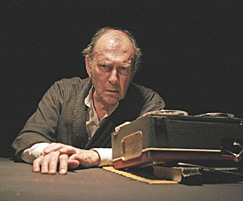
Harold Pinter died on Christmas Eve. When the news was released on Christmas Day, poters on the BBC's Have Your Say site rushed to condemn him, as though there were a peculiar merit in being first to condemn a man after he has died.

I don't understand that attitude. When icons of the right - even dictators - die, I try not to rejoice. I may sometimes feel relieved that people are free from fear as a result but there's something disgusting in publicly rejoicing at a fellow-human's death. Those who have suffered abuse or worse may be allowed their celebrations but these come from so twisted a world and so bad an experience that we should offer sympathy and understanding rather than trying to outdo them in shrieking hurrahs.

Many people disliked Pinter. He wasn't afraid of controversy and, like all of us, was imperfect. But he was willing to speak for those in need of help and for those who were threatened by state power. I wouldn't always agree with him but I admired his willingness to be engaged and to speak out, when silence would have been easier. I wonder how much his sympathy with oppressed people grew out of his experience as a Jewish tailor's son at school in the East End of London. He must have been fourteen or fifteen when the newsreel film of Belsen was shown in cinemas. Yet he became a conscientious objector in the late 1940s and, more recently, associated himself with Jewish campaigners who called for justice for Palestinians as well as Jews in Israel. These weren't popular or easy positions to hold.

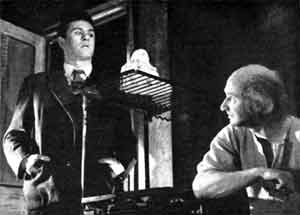
Many of the swift attacks on Pinter target his work as a playwright, calling him "talentless," "shallow" and, of course, "intellectual." There's a laziness in most of the criticism. As a playwright, Pinter continually experimented and took risks. He also, in his early plays, wrote about working-class people - not nice, cosy, working-class people but people who were complex, hopeful, dangerous, often at odds with their society and one another. I'm no expert on Pinter's plays but they make me think - and that's high praise.

As a writer, Pinter cared about language and its relation to truth. The lecture he gave after receiving the Nobel prize for literature has, as its title, "Art, Truth and Politics." it was deeply concerned with two subjects: the way in which language can be abused to conceal the truth and the way in which government and the media prevent us from knowing the acts of horror which are committed on our behalf. Pinter's speech, famously, attacked the United States' role in supporting military dictatorships, and the way in which the United States' conduct is widely ignored. With corruscating irony, Pinter said:

"
It never happened. Nothing ever happened. Even while it was happening it wasn't happening. It didn't matter. It was of no interest."

And that's true of so many horrors, from bombing civilians to starvation and the destruction of the planet. It's easier not to know. It's certainly easier not to think about the grief, the corpses, the injuries, the sheer mess of wars and bombings conducted on our behalf. Again in his Nobel lecture, Pinter quoted Neruda (writing of Republican Spain):

"
Come and see the blood in the streets.
Come and see
the blood in the streets.
Come and see the blood
in the streets!"

Harold Pinter insisted that we see the reality, sure that if enough people saw what was really happening elsewhere, their common humanity and decency would ensure a gentler and more generous outcome.

Pinter's death came only four days after the death of another campaigning writer, the poet Adrian Mitchell. He too was concerned that people see and acknowledge the truth. His most famous poem, "To whom it may concern," was written about Vietnam but many of its words can be applied to all sorts of uncomfortable truths that we would prefer not to know. The economy is built on debt and injustice. We have prospered because other people starve. Our government sends its servants to lie, torture, maim and kill. Children born in this country are locked away because their parents are asylum-seekers. Even in Britain - even in peaceful suburbs - our fellow humans sleep in doorways and on pavements and don't have enough to eat. Lies are more comfortable. We can live in our cosy world where "Nothing ever happened" and choose the newspaper that tells us our lies of choice.


Labels: , , , , , , , , , , , , , ,

Monday, May 05, 2008

"The sword, the mace, the crown imperial"


posted by k

When I was quite young, I was fascinated by the cast gallery in the Victoria and Albert Museum. This was partly because of the stern notice on the door, forbidding children under 15 from unaccompanied entry. I assumed - and still think - this was because of the fragility of the exhibits though it may have been because of the cast of Michaelangelo's David. I was too young to find his nudity particularly interesting or surprising. There were plenty of nudes in the National Gallery and British Museum and, for that matter, on public statues. But although I gazed in fascination at other works - Donnatello's little David and the massive cartoon-stories on Trajan's Column, it was Michaelangelo's David I liked to see. I visited the museums with my younger brother and would lurk outside the cast gallery, looking for a friendly-seeming grown-up who would act as my escort. Nowadays the whole idea would fill parents and social workers with anxiety, but my younger brother and I came to no harm. After all, at eight or nine I was old enough to be sensible and independent on a day out.

It was David's expression that fascinated me. Was he confident or was he afraid? I could never decide from the smooth, white, imitation marble. I still didn't know years later, when I saw the original sculpture and outdoor, in Florence.

I didn't know what David was meant to signify: the idea that he signified anything beyond his own story would have seemed strange to me. Now I learn that he stood for Florence itself and that the huge figure represented small, vulnerable Florence as an embattled city state. David seems to have retained that meaning through the centuries as various rulers and governments have co-opted him. Even the wealthy and powerful like to think of themselves as vulnerable defenders of peace and liberty.

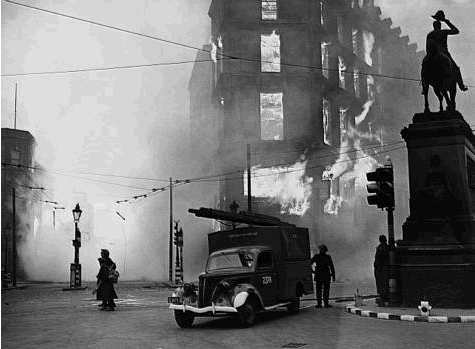
I grew up with different myths of vulnerability. Like most myths, they were founded on a truth. What happened to Britain in the Blitz was terrifying (so was the bombing of Dresden and Nagasaki) and the courage of Londoners and others was rightly praised. I heard enough of air-raids and fires from my parents to know that it had been very bad indeed. Living through bombing, coping with daily news of death and injury and simply carrying on took immense courage - a courage that became a way of daily life.

From tales of the Blitz, from the story of Dunkirk, I learnt a myth of Britain: plucky little Britain, defender of liberty and democracy, standing alone against the fascist foe. This was merged with later knowledge to suggest that Britain fought Germany because of Nazi treatment of the Jews and other oppressed groups (gypsies, homosexuals, communists, dissidents, etc.). That wasn't so, although many individuals joined up because of the known evils of Nazism. Britain fought because Germany invaded Poland and because Britain itself was threatened. The treatment of minorities was seen as a domestic matter. There was considerable anti-semitism in Britain, even during wartime, and the opposition to Jewish immigration in particular prefigures current prejudice against asylum seekers who flee to Britain from torture and death.

Suffering did not make Britain a better, more tolerant place. It didn't prevent Britain from pursuing brutal imperialist policies elsewhere. The myth of small, suffering Britain enabled people - including me - to look away from the truth. I didn't notice what was happening in the Chagos Islands. I've only recently realised that the barbarous mistreatment of the islanders - which continues as our current Labour government refuses to obey court judgments and let the islanders return - was part of a well-established imperial agenda.

We in Britain are so used to the idea of our country as a guardian of freedom that this reads like mad extremism. But what else can I call it, when I read the words of the chief of the Imperial General Staff, Field Marshal Sir John Harding, in 1955? He had been sent to ensure Cyprus continued as a useful British base; his mission was to prevent independence at all costs so that Cyprus could remain as a useful base for operations in the Middle East. Sir John Harding wrote to the British cabinet that, if Cypriot self-determination were to be prevented, "a regime of military government must be established and the country run indefinitely as a police state." The British cabinet accepted Sir John Harding's advice. Ministers were happy to run police states elsewhere if they contributed to Britain's safety or economic advantage. That is what imperialism means.

It's one of many passages that struck me in a long, informative article by Perry Anderson on the recent history of Cyprus in the London Review of Books. I hadn't known much about the history of Cyprus before. When I was at school, the British press treated Archbishop Makarios as a figure of fun but he emerges from the LRB article as a figure of far more integrity than the British cabinet ministers, civil servants and soldiers who opposed him. The British government encouraged and orchestrated brutality for its own interests, regardless of the rights, well-being or lives of its Cypriot subjects. And when things went wrong, Britain's Labour government, under Prime Minister James Callaghan, asked the United States for help - "an instinctive reflex in Labour," Perry Anderson comments.

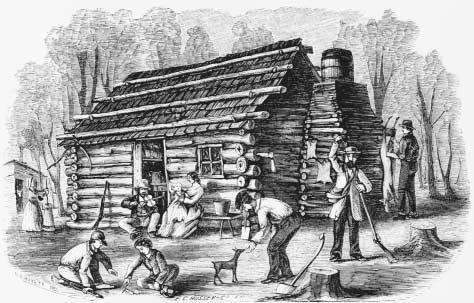
The United States also presents itself as small and vulnerable. The myth of the frontier is still strong and U.S. citizens rightly recall the courage of people who trekked across the country and built communities in the wilderness. But the wilderness wasn't uninhabited. As the new settlers established themselves and finally fought back against the oppression of imperial Britain, they also sought to subdue the original inhabitants of their country. George Washington outlined his strategy in his commands to General John Sullivan in May 1779:

"The Expedition you are appointed to command is to be directed against the hostile tribes of the Six Nations of Indians, with their associates and adherents. The immediate objects are the total destruction and devastation of their settlements, and the capture of as many prisoners of every age and sex as possible. It will be essential to ruin their crops now in the ground and prevent their planting more."

"I would recommend, that some post in the center of the Indian Country, should be occupied with all expedition, with a sufficient quantity of provisions whence parties should be detached to lay waste all the settlements around, with instructions to do it in the most effectual manner, that the country may not be merely overrun, but destroyed."


"But you will not by any means listen to any overture of peace before the total ruinment of their settlements is effected. Our future security will be in their inability to injure us and in the terror with which the severity of the chastisement they receive will inspire them."

Terror was Washington's weapon in the American War of Independence - or the American Revolution as it is sometimes known. The settlers who were becoming a nation thought terror a fair tactic to achieve the just society they envisaged - and that America's original inhabitants were proper victims. Less than three years previously, Washington had signed the Declaration of Independence, which included the words:

"We hold these truths to be self-evident, that all men are created equal, that they are endowed by their Creator with certain unalienable Rights, that among these are Life, Liberty and the pursuit of Happiness. - That to secure these rights, Governments are instituted among Men, deriving their just powers from the consent of the governed, - That whenever any government becomes destructive of these ends, it is the Right of the People to alter or to abolish it, ..."

Today, Britain and the United States continue to use terror to further a modern imperial agenda. But we are constantly told that terror is what other people employ, and we have complex organisations - not fully accountable to democratic government - to defend us from the "terrorist threat". Liberty is curtailed in the United States and in Britain, with popular support.

The myths we hold dear talk of ideals - liberty, democracy, equality - which are still valuable. But unless we unpick the myths and look at historical facts - and our current practices - we'll find it hard to safeguard the values we should hold dear.

Labels: , , , , , , , , , , , , , , , ,

Monday, October 08, 2007

"a bloodthirsty and unconstitutional force"

posted by k
(with apologies for double-posting)

Accusations flew. Counter-accusations parodied the voice of authority. It was It was 1839.

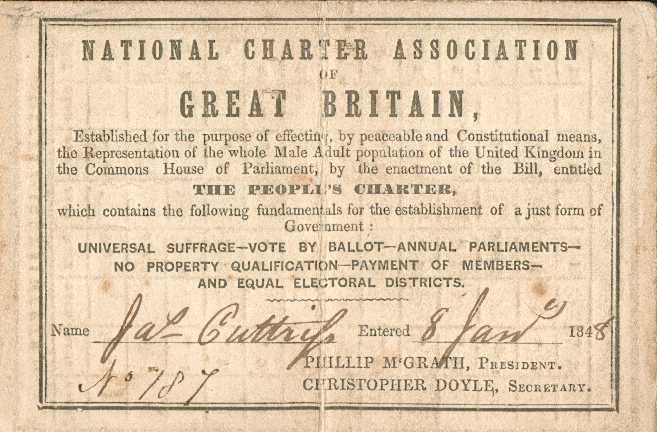
Memories of the Peterloo Massacre and authorised brutality were strong. But the Chartists were determined on reform. The ideas came from working-class people and their demands were simple.

The Charter had six points:

1. annual general elections
2. universal manhood suffrage
3. secret ballot
4. abolition of property qualifications of MPs
5. payment of MPs
6. equal electoral districts and redistribution of seats

These demands don't seem very radical today. We don't have annual parliaments but the question of fixed-term parliaments is being discussion again. All other points are taken for granted. In 1839 the Chartists were treated as dangerous revolutionaries.

On 4th July police were brought from London to break up a demonstration in the Birmingham Bull Ring. Placards produced by the Chartist convention described the Metropolitan police as "a bloodthirsty and unconstitutional force." William Lovett, the peaceable secretary of the convention, was later tried with the man who took the placards to the printer. Lovett was sentenced to a year's imprisonment for seditious libel.


The first Chartist petition was three miles long with 11 million signatures (including some forgeries). On 12th July it was presented to parliament by Thomas Atwood MP. Benjamin Disraeli was among the MPs voting to debate the petition. But MPs decided, by a majority of 235 to 46, that they wouldn't consider it. So there was no debate on its provisions before the petition was rejected.

There were always some Chartists in favour of physical force, if moral arguments failed. After the rejection of debate on the petition, a series of risings took place. The Newport Rising on 4th November attempted to free political prisoners from the Newport's Westgate Hotel. About 20 Chartists were killed. Three leaders of the rising were found guilty of high treason and sentenced to be hung, drawn and quartered. The sentences were later commuted to transportation for life.

In this atmosphere of fear and repression the government passed the 1839 Metropolitan Police Act. It's a wide-ranging law, rather like the Serious Organised Crime and Police Act of 2005 - the act which bans everybody except Brian Haw from unlicensed demonstrations, placard-holding and badge-wearing in central London. The 1839 Metropolitan Police Act includes stop and search provisions, laws against "furious driving" (of carts), provisions against causing annoyance by kite-flying or ringing doorbells, a ban on blowing horns and lots of provisions against bad language. It also includes a sessional order to ensure that MPs can reach parliament without being obstructed.

This is the law which the government is using the ban the anti-war demonstration today. I wonder what the police will do about David Howarth MP, who plans to join the protest. Perhaps they'll arrest him for attempting to obstruct himself. This would be a shame because he's due to table a Bill which comes close to the one aim of the Chartists that has not yet been accomplished: fixed-term parliaments.


There are uncomfortable echoes of those repressive days in which Chartists were jailed and sentenced to death. However, it's good to see that I can now find Craig Murray's blog in its familiar form by typing the url www.craigmurray.org.uk . It still doesn't take comments and there are no new posts. But I look forward to reading Craig Murray again.


STOP PRESS: Permission was finally given for the march less than an hour before it was due to begin. The government changed its mind in February 2003 as well. In 2003 they gave a little more notice.


Labels: , , , , , ,

Thursday, July 26, 2007

Did I miss something?

posted by k
(with apologies for double posting)


Did I miss something?

I read the newspapers yesterday and found that Gordon Brown (our prime minister - it's hard to get used to the change) was threatening a state of emergency. No-one seemed shocked or surprised. No-one made it the lead story in the papers this morning.

I keep looking at accounts of what was said. I keep hoping I've got this all wrong.

Gordon Brown said that he planned to ask parliament to double the time suspects could be detained without trial. He said there were two main options: either parliament would vote as he said or, whenever he wanted to hold suspects for longer, he would declare a state of emergency which would allow him to detain suspects for a further thirty days.

Presumably Mr Brown is talking about the Civil Contingencies Act 2004. This allows the Prime Minister or other Ministers to make legislation without consulting parliament in certain situations. According to section 19 of the Act, these are:


(a) an event or situation which threatens serious damage to human welfare in the United Kingdom or in a Part or region

(b) an event or situation which threatens serious damage to the environment of the United Kingdom or of a Part or region, or

(c) war, or terrorism, which threatens serious damage to the security of the United Kingdom


Presumably Gordon Brown will claim that section (c) applies. That won't be accurate. Gordon Brown is threatening MPs and peers with a state of emergency should they dare to vote against him. The "emergency" he claims is the failure of parliament to do the bidding of the prime minister. That's not how parliament is supposed to work.

Parliament is supposed to be a democracy. Our elected representatives are supposed to vote on the law.

The Civil Contingencies Act is a very dangerous law. It allows the Prime Minister, acting alone, to amend any Act of Parliament except the Human Rights Act 1998 for the period of the emergency. When the Act was debated, Members of the House of Lords attempted to protect laws that they regarded as fundamental to the British constitution. They were unsuccessful. If the Prime Minister declares a state of emergency he can even suspend the following laws:


Bill of Rights 1689

Act of Settlement 1700

Habeas Corpus Act 1816

Parliament Act 1911 (limiting parliaments to five years)

House of Commons Disqualification Act 1975


After thirty days, he has to ask for parliament's approval.

We have a new prime minister who has warned our elected representatives that if they don't do as he says, he'll stamp his foot and rule without them for a month. If they won't let him lock people up for longer, he'll say it's an emergency and do it anyway.

What else might Mr Brown do in those thirty days of emergency?

What would be left when the emergency was over?

Where are the protests?

Labels: , , , , , ,

Sunday, July 08, 2007

"true allegiance"


posted by k

As a Brit, I find it slightly disturbing that children in the United States are expected to pledge allegiance to a gaudy piece of cloth. The pledge began with good intentions (the first version was written by a Christian Socialist). However, the idea of equality was omitted - apparently the text could only be agreed by making concessions to misogynists and racists.

The United States came into being with the Declaration of Independence, setting out the grounds on which a colony had the right to initiate revolution against a tyrannical ruler. It's still worth reading.

British subjects (Britain does not have citizens) can vote for qualified candidates for parliament. But MPs who don't believe in monarchy can't take their seats unless they're prepared to lie. Even the most moderate republican - someone who would do no more than vote for a republic if given the chance - is banned from taking a seat in parliament. Electors are allowed to vote for an honest republican but, should they do so, they will not be represented in parliament.

All new Members of Parliament and Members of the House of Lords are compelled to swear an oath of allegiance to the queen and her heirs.

A country which bars electors from choosing the representatives of their choice is not a democracy.

Gordon Brown has started a debate about constitutional reform.

The country may not be ready to become a republic. It may not be ready to debate the choice between a monarchy and a republic. But surely it's time to allow honest republicans to take their seats in the House of Commons.

There's a new petition on the Downing Street website. The text is simple and straightforward:

We the undersigned petition the Prime Minister to ensure that the Oath taken by Peers and MPs no longer pledges loyalty to the Monarchy.


You can sign the petition by clicking HERE.


Labels: , , , , , , , , , , , , , , , ,

Friday, May 25, 2007

"necessity, the tyrant's plea"


posted by k (again, a post taken from elsewhere)

Help! Panic now! This is DANGEROUS!!!!


Home Secretary John Reid - the one who's resigning with Tony Blair - has said he may declare a State of Emergency. This is because three non-dangerous prisoners who have never been convicted (as described here) have gone missing.

It seems a slight over-reaction.
But according to the Guardian, which has recently transformed itself into a right-wing anti-libertarian newspaper (as demonstrated by some of its Comment columns), unnamed MPs fear their control orders may are turning them into "a laughing stock". And our leaders don't like being laughed at.

Besides that, John Reid has several complaints. For a start, control orders
may be illegal. Of course, that would mean the government is breaking the law and not the escaped prisoners. Reid has been keeping them under house arrest regardless of a High Court ruling against him, in the hope that he can get support from the Court of Appeal or the Law Lords. Apart from control orders, MPs refused to let the Home Secretary imprison people without charge for more than 28 days. The courts and parliament are against Reid and people have started laughing at him. What is he to do?

So far as I can see, Ministers can declare a State of Emergency under the
2004 Civil Contingencies Act if there is a state of war, an environmental disaster, a major act of terrorism or a natural disaster. I wonder which of these categories includes the disagreement of parliament and the courts - not to mention the risk of public laughter.

It all sounds so unlikely. But the risks presented by this legislation have been identified. And it seems quite clear that the government wants to suspend parts of the European Human Rights convention - unless, of course, the judges do exactly as they are told.

Surely Parliament won't let this happen, Surely, if necessary, people will take to the streets and defend democracy and the rule of law. We know what happens when governments take power into their own hands and away from parliament and the courts. Don't we?

Labels: , , , , , , , , , , , ,