Thursday, June 12, 2008

We Have Been Advised of The Price of Liberty

"They that can give up essential liberty to obtain a little temporary safety deserve neither liberty nor safety." -- Benjamin Franklin, Historical Review of Pennsylvania (1759)

At 6.35pm on Wednesday 11th June 2008, the UK House of Commons passed the Counter Terrorism Bill. With the the £1.2bn bung to Ulster to gain the support of the nine Democratic Unionist Party MP's, the price of liberty has been established as £85.7 million pounds a day.

A brief history. It was the Terrorism Act 2000 which introduced a provision for terror suspects to be held for 48 hours This could be extended to seven days with the permission of a judge. In 2003,that was extended to14 days and in 2006 to 28 days. We might expect certain Senior Police officers wll continue to press for the need for further extensions to that limit in order to psychologically destroy a segregated and degraded suspect. Blair argued for a 90 day detention limit, on advice from senior Police and Security staff.

Six days felt like six years. I dread to think what 42 days would feel like.” Ratzwin Sabir, a postgraduate student at the University of Nottingham, was detained under the Terrorism Act for the offence of downloading (and arranging printing of) an edited al-Qaida training manual from a US Government website. For his dissertation. It has been reported that it was a junior clerical staff-member at the University who advised the Police of the matter.

As a nation, the people of the United Kingdom have yet another reminder that, in the eyes of both the Government and those who act as its security agents, the principles of liberty, of justice, of rights, have no longer any place in the scheme of things. And will use scurrilous political means to get their way. Even if the authority for the matter has been eroded by the unusual strength of the rebellion by Labour MP's' who have, in large part, been historically supine.

"In the end, more than they wanted freedom, they wanted security. They wanted a comfortable life, and they lost it all -- security, comfort, and freedom. When ... the freedom they wished for was freedom from responsibility, then Athens ceased to be free." Sir Edward Gibbon 1737 – 1794.

Dodo

Labels: , , ,

Thursday, May 22, 2008

"The proper study of mankind"

posted by k

It was big news. The first ever terrorist arrest in Nottingham - on the campus of Nottingham University. The local paper said the police had been tipped off by "senior university figures." There were plenty of students willing to tell journalists how shocked and outraged they were. The 7/7 bombings were mentioned and the press were briefed that the two men arrested of Pakistani descent.

Police were given extra time to question the men, so that they could search "premises connected" with them. (This probably meant their homes, but "premises" is a more alarming word.)

Then, nearly a week later, news was released that the men had been released without charge. It wasn't such a big news story. One had been re-arrested for possible immigration offences. It's strange how often that happens. It makes me think that, with all the forms immigrant have to fill in, it's probably quite easy to make a mistake.

But this time one of the men arrested is speaking to the press. The Nottingham Evening Post offers a fuller story tomorrow.

The Times Higher Education Supplement is also reporting the story. E-mails are giving the background. It seems there weren't any terrorists. There was a registered postgraduate student working towards a Ph.D. on Islamic terrorism. As part of his research, he downloaded an Al-Qaeda training manual. He didn't join a terrorist cell to find it - he went to a United States government website which had made an edited version publicly available. Then he sent it to a friend - a member of university staff in another department - asking him to print out. The extension to the warrant was given because the two men owned computers and mobile phones. And the university is now saying that the police were tipped off by a junior clerical employee and not a senior member of staff.


The student's tutor, who knew all about his research, is shocked that police could cause problems for a student pursuing such relevant research. But a university spokesman says that the edited version of the Al-Qaeda handbook is "not legitimate research material."

That seems strange to me. If I were researching Islamic terrorism in a politics department, I'd want to read what Al-Qaeda says. Research involves acquiring knowledge and researchers may have to look at material they don't much like.

I don't know all the details of the case. But if knowledge and learning are valued, academic freedom is vital.

Two men were arrested for looking at material which was made publicly available by the United States government. I don't think that should be grounds for arrest.

Press stories of the arrests raised fears of a terrorist threat in Nottingham. How many people are arrested like this, with great publicity? How many are then released without charge and without apology? And what happens next?


Labels: , , , , , , , ,

Monday, May 05, 2008

"The sword, the mace, the crown imperial"


posted by k

When I was quite young, I was fascinated by the cast gallery in the Victoria and Albert Museum. This was partly because of the stern notice on the door, forbidding children under 15 from unaccompanied entry. I assumed - and still think - this was because of the fragility of the exhibits though it may have been because of the cast of Michaelangelo's David. I was too young to find his nudity particularly interesting or surprising. There were plenty of nudes in the National Gallery and British Museum and, for that matter, on public statues. But although I gazed in fascination at other works - Donnatello's little David and the massive cartoon-stories on Trajan's Column, it was Michaelangelo's David I liked to see. I visited the museums with my younger brother and would lurk outside the cast gallery, looking for a friendly-seeming grown-up who would act as my escort. Nowadays the whole idea would fill parents and social workers with anxiety, but my younger brother and I came to no harm. After all, at eight or nine I was old enough to be sensible and independent on a day out.

It was David's expression that fascinated me. Was he confident or was he afraid? I could never decide from the smooth, white, imitation marble. I still didn't know years later, when I saw the original sculpture and outdoor, in Florence.

I didn't know what David was meant to signify: the idea that he signified anything beyond his own story would have seemed strange to me. Now I learn that he stood for Florence itself and that the huge figure represented small, vulnerable Florence as an embattled city state. David seems to have retained that meaning through the centuries as various rulers and governments have co-opted him. Even the wealthy and powerful like to think of themselves as vulnerable defenders of peace and liberty.

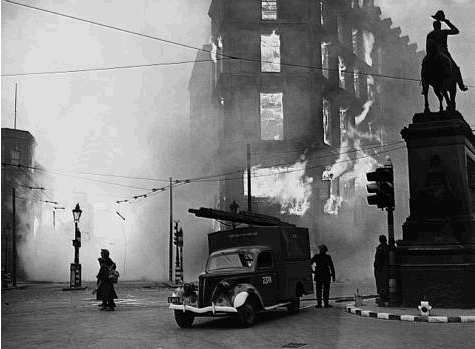
I grew up with different myths of vulnerability. Like most myths, they were founded on a truth. What happened to Britain in the Blitz was terrifying (so was the bombing of Dresden and Nagasaki) and the courage of Londoners and others was rightly praised. I heard enough of air-raids and fires from my parents to know that it had been very bad indeed. Living through bombing, coping with daily news of death and injury and simply carrying on took immense courage - a courage that became a way of daily life.

From tales of the Blitz, from the story of Dunkirk, I learnt a myth of Britain: plucky little Britain, defender of liberty and democracy, standing alone against the fascist foe. This was merged with later knowledge to suggest that Britain fought Germany because of Nazi treatment of the Jews and other oppressed groups (gypsies, homosexuals, communists, dissidents, etc.). That wasn't so, although many individuals joined up because of the known evils of Nazism. Britain fought because Germany invaded Poland and because Britain itself was threatened. The treatment of minorities was seen as a domestic matter. There was considerable anti-semitism in Britain, even during wartime, and the opposition to Jewish immigration in particular prefigures current prejudice against asylum seekers who flee to Britain from torture and death.

Suffering did not make Britain a better, more tolerant place. It didn't prevent Britain from pursuing brutal imperialist policies elsewhere. The myth of small, suffering Britain enabled people - including me - to look away from the truth. I didn't notice what was happening in the Chagos Islands. I've only recently realised that the barbarous mistreatment of the islanders - which continues as our current Labour government refuses to obey court judgments and let the islanders return - was part of a well-established imperial agenda.

We in Britain are so used to the idea of our country as a guardian of freedom that this reads like mad extremism. But what else can I call it, when I read the words of the chief of the Imperial General Staff, Field Marshal Sir John Harding, in 1955? He had been sent to ensure Cyprus continued as a useful British base; his mission was to prevent independence at all costs so that Cyprus could remain as a useful base for operations in the Middle East. Sir John Harding wrote to the British cabinet that, if Cypriot self-determination were to be prevented, "a regime of military government must be established and the country run indefinitely as a police state." The British cabinet accepted Sir John Harding's advice. Ministers were happy to run police states elsewhere if they contributed to Britain's safety or economic advantage. That is what imperialism means.

It's one of many passages that struck me in a long, informative article by Perry Anderson on the recent history of Cyprus in the London Review of Books. I hadn't known much about the history of Cyprus before. When I was at school, the British press treated Archbishop Makarios as a figure of fun but he emerges from the LRB article as a figure of far more integrity than the British cabinet ministers, civil servants and soldiers who opposed him. The British government encouraged and orchestrated brutality for its own interests, regardless of the rights, well-being or lives of its Cypriot subjects. And when things went wrong, Britain's Labour government, under Prime Minister James Callaghan, asked the United States for help - "an instinctive reflex in Labour," Perry Anderson comments.

The United States also presents itself as small and vulnerable. The myth of the frontier is still strong and U.S. citizens rightly recall the courage of people who trekked across the country and built communities in the wilderness. But the wilderness wasn't uninhabited. As the new settlers established themselves and finally fought back against the oppression of imperial Britain, they also sought to subdue the original inhabitants of their country. George Washington outlined his strategy in his commands to General John Sullivan in May 1779:

"The Expedition you are appointed to command is to be directed against the hostile tribes of the Six Nations of Indians, with their associates and adherents. The immediate objects are the total destruction and devastation of their settlements, and the capture of as many prisoners of every age and sex as possible. It will be essential to ruin their crops now in the ground and prevent their planting more."

"I would recommend, that some post in the center of the Indian Country, should be occupied with all expedition, with a sufficient quantity of provisions whence parties should be detached to lay waste all the settlements around, with instructions to do it in the most effectual manner, that the country may not be merely overrun, but destroyed."


"But you will not by any means listen to any overture of peace before the total ruinment of their settlements is effected. Our future security will be in their inability to injure us and in the terror with which the severity of the chastisement they receive will inspire them."

Terror was Washington's weapon in the American War of Independence - or the American Revolution as it is sometimes known. The settlers who were becoming a nation thought terror a fair tactic to achieve the just society they envisaged - and that America's original inhabitants were proper victims. Less than three years previously, Washington had signed the Declaration of Independence, which included the words:

"We hold these truths to be self-evident, that all men are created equal, that they are endowed by their Creator with certain unalienable Rights, that among these are Life, Liberty and the pursuit of Happiness. - That to secure these rights, Governments are instituted among Men, deriving their just powers from the consent of the governed, - That whenever any government becomes destructive of these ends, it is the Right of the People to alter or to abolish it, ..."

Today, Britain and the United States continue to use terror to further a modern imperial agenda. But we are constantly told that terror is what other people employ, and we have complex organisations - not fully accountable to democratic government - to defend us from the "terrorist threat". Liberty is curtailed in the United States and in Britain, with popular support.

The myths we hold dear talk of ideals - liberty, democracy, equality - which are still valuable. But unless we unpick the myths and look at historical facts - and our current practices - we'll find it hard to safeguard the values we should hold dear.

Labels: , , , , , , , , , , , , , , , ,

Thursday, September 13, 2007

The Juggernaut of Subjection

A summary of the principal legislative sources of the erosion of
rights and freedoms in Britain becomes cumulatively chilling.
This entirely excludes all of the procedural shifts which facilitate
the huge expansion of (for example) CCTV. Or the
fingerprinting of children in schools without prior parental consent.

I have avoided entering commentary on the shift in the Zeitgeist and
the obfuscation which has permitted the general public acceptance
(and even support) of such cumulative repression.

Further commentary can be found with the intelligent use of Search engines.
Preferably other than Google if you want to keep your browsing habits
untracked. Do not forget that the information collection for
marketing purposes by Corporate Institutions, from Google to Tesco, is
a further reflection of the extent of the erosion of the liberty to lead your
life without unseen monitoring or intervention. In this, there is a meeting
of minds within the realms of both Civil and Corporate Governance.


CRIMINAL JUSTICE AND PUBLIC ORDER ACT 1994

Abolishes a suspect's right to silence (by permitting Courts and
Juries to draw inference from a suspect's refusal to disclose
matters to the Police at the time of arrest).


POLICE ACT 1997

Allows the police to break into property and install
electronic surveillance.
A chief constable can make such authorisations if he
believes it will help fight serious crime.
The occupier of the property need not be under suspicion of a crime.
The decisions can be taken without a warrant. (Sections 91 to 108)


CRIME AND DISORDER ACT 1998

First facilitation of ASBO's and the conception of causing Harassment,
Distress or Alarm. Introduction of Parenting Orders and Curfews on
Offenders released on Licence.


IMMIGRATION AND ASYLUM ACT 1999

Among other matters, facilitating the establishment of Detention Centres.

TERRORISM ACT 2000

Definition of “terrorism” close to catch-all..
The government can proscribe organisations without
having to prove that they have committed any offence.


REGULATION OF INVESTIGATORY POWERS ACT 2000

Authorises Surveillance and disclosure of Communications
largely without warrant.

Authorities able to do so range from any Police Force to include any
Local Authority and the FSA.


FOOTBALL (DISORDER) ACT 2000

Enables courts to place banning orders on people, prohibiting
them from travelling when a football match is on, without proving
they committed an offence.

Allows the police to prevent a person without a banning order
from leaving the country if the police have “reasonable grounds”
for believing the person may cause trouble at a football match.


HEALTH AND SOCIAL CARE ACT 2001

Enables the Health Secretary to authorise disclosure of
confidential patient information to anyone he chooses if he
believes it is in the public interest or will improve patient
care.


ANTI-TERRORISM, CRIME AND SECURITY ACT 2001

Allows government departments and public bodies to disclose
confidential information to police forces for the purposes
of investigations of any crime anywhere in the world.

Permits the Home Secretary to certify any foreigner as an
“international terrorist” if he/she decides that they are
a risk to national security.
Terrorism is defined as in the Terrorism Act 2000.
Section 29 prevents courts from challenging the detention of
foreigners under sections 21 – 26,.


SOCIAL SECURITY FRAUD ACT 2001

Officials authorised by local councils and the Department of
Work and Pensions can demand that banks, credit card companies,
utility companies, any company providing financial services
and phone companies hand over any data they think is necessary
for the purposes of preventing or detecting benefit fraud,
without a warrant.
These officials can also demand that telecommunications companies
tell them who owns a particular account, when given only a number
or electronic address associated with the account,
again without a warrant.


THE PROCEEDS OF CRIME ACT 2002

Under this Act, the Criminal Assets Recovery Agency is set up
and in Part 5, it is given the power to seize a person's assets
using civil procedures in court.
This law applies civil proceedings to a dispute between the state
and an individual, with the state as the adjudicator.


ANTI-SOCIAL BEHAVIOUR ACT 2003

Extends the thinking behind ASBOS and includes premises closure,
obligations on landlords, parenting orders, dispersal of groups,
public assemblies (the 1986 Public Order definition of an assembly
reduced from 20 to 2).

EXTRADITION ACT 2003

Part 2 - unratified treaty with USA. No prima facie evidence
required for extraditions from the UK to the USA, but still
required for USA to UK extraditions.

Part 1 of the Act implements European Arrest
Warrant extraditions.
There is no requirement for evidence to be heard before a UK Court.
Also refer to the
Home Office website.

THE CRIMINAL JUSTICE ACT 2003

Facilitates the elimination of Juries from complex fraud cases.
Removes protection against “double jeopardy”. Permits hearsay evidence.


THE CIVIL CONTINGENCIES ACT 2004

Authorises any cabinet minister to make "emergency regulations"

Emergency regulations may make any provision that can be made by
Royal Prerogative or Act of Parliament.....
the FIRST of the real shifts towards Enabling Act thinking.


THE PREVENTION OF TERRORISM ACT 2005

Under this Act, the government can impose “control orders” on
anyone they suspect might be involved in “terrorism-related”
activity.

The person subjected to a control order does not get a trial,
is not charged with anything, and may have the evidence or
accusations against them withheld from them or their lawyers.
Terrorism is defined as in Section 1 of the Terrorism Act 2000


THE SERIOUS ORGANISED CRIME AND POLICE ACT 2005

Sets up the Serious Organised Crime Agency (SOCA)
All offences, no matter how trivial, are now arrestable,
granting powers to obtain DNA, intimate samples, fingerprints
and photographs of those arrested,
to be retained on file regardless of whether the suspect is
charged with or convicted of an offence.
Don't discard your cigarette butt.
Protestors, even a single protestor, must apply at least 24
hours (and more normally 6 days) in advance for a permit
to protest within 1km of Parliament.


LEGISLATIVE AND REGULATORY REFORM ACT 2006

Originally drafted in terms which would have made this an
Enabling Act, the diluted text with some safeguards introduced
remains the second part of Enabling thinking.
By this, Ministers can, with minimal Parliamentary
scrutiny, modify and enact regulations, interpretations,
resources targeting and law.


IMMIGRATION, ASYLUM AND NATIONALITY ACT 2006

Further powers tor restrict the rights of immigrants
and asylum seekers.

Sections 56 and 57 modify the British Nationality Act (1981)
to permit the Home Secretary to deprive a person of citizenship
or the right of abode.


TERRORISM ACT 2006

Further clarification of offences of glorification etc.
Extends detention period.

IDENTITY CARDS ACT 2006

Well publicised. Read and weep.
Also introduces the National Identity Register.
More detail of this and other intrusive measures at
the No2ID resource.

There are times when I feel utterly lost, demotivated, by this
juggernaut of intervention, the abuse of an authority with a
“reasonable” face. The perversion of minds continues through
misrepresentation, through propaganda, through
an arrogance of rectitude which denies freedom in the name
of some collective "security".
Measures such as these laws were not deemed necessary
during the IRA campaign from 1969 to 1997.
Nor, for that matter, during the Second World War of
the last century.

How much freedom will you give up for a Government's definition
of what it is which should make you feel secure?
For the Government's actions in the name of "security" do nothing
to ease any personal sense of vulnerability. They act in the
enhancement of fear.

Remember Pastor Niemoller.

Dodo

(">

Labels: , , , , , , ,

Wednesday, May 09, 2007

"an appearance of solidity"


posted by k

We now have a Ministry of Justice and a Minister of Justice. The language alarms me; it's a little too close to Orwell's Ministry of Truth. But then, the Health Ministry deals with sickness and the Minister of Employment is concerned with unemployment (or "job seeking" as it is now known). Perhaps the Ministry of Defence will soon be called the Ministry of Peace. "Ministry of Attack" might be a more honest name.

It's hard to see what the effects of the new ministries will be. The new Home Office, with its concern for telephone taps, immigration and surveillance seems like the U.S. Department for Homeland Security.

The Ministry of Justice remains controversial. I hope that the objectives of the Office for Criminal Justice Reform don't mean quite what they say; increasing "the number of crimes for which an offender is brought to justice to 1.25 million" is ambiguous at least. Presumably they don't really want to increase the number of crimes on the statute book to quite so high a number, nor to ecnourage criminal acts. A ratio between crime and conviction might be a better aim.

Meanwhile the hasty change leaves people uncertain. David Pannick's article in yesterday's Times is measured and thought-provoking. The relationship between parliament and the judiciary requires thought and attention. If justice doesn't protect everyone equally, it has ceased to be justice. And the government's tendency to attack decisions of the courts suggests a disregard for both justice and parliamentary process. After all, the government proposes laws which parliament debates, amends and passes or rejects. The courts' role is to uphold the laws that parliament has made.

To attack the courts is to bypass parliament and undermine the law.

Labels: , , , , , , , , ,

Sunday, April 22, 2007

Lies, damned lies and statistics

According to a Europol Report, of 498 “Terrorist” attacks in 11 EU member states during 2006, just one (failed) was carried out by a group which could be classed as “Islamist”. That in Germany. The only fatal attack, with the deaths of two people in Madrid, was carried out by ETA, the Basque group, who were responsible for 136 attacks.

Of the 14 member states surveyed, statistics on arrest were available in 13 (the UK does not provide statistics on cases awaiting trial). Of 706 suspects arrested in relation to terrorist offences, 257 were “Islamist”. That bastion of liberté, egalité, fraternité, France, accounted for 342 of these arrests of which 139 were “Islamist” and 188 “Separatist”. (Little reported in the UK, where I write, there were 283 separatist attacks in Corsica during 2006).

The report does not include information on the activities of the security services, nor the role of such as Eliza Manningham-Buller (Director General of MI5 until her retirement last week - April 2007) in emphasising the extent of the terrorist threat. There is no means for public scrutiny of the accuracy of the PR from such security services.

I live in the UK, a land where our liberties of action, association, comment and privacy have been shattered over the past decade, principally in the years following the WTC atrocity. I live in a nation which was the focus for a sustained Irish Terrorist assault. Yet even after the bomb at the Grand Hotel (12th October 1984) which almost assassinated the Prime Minister, the Government saw no cause for such draconian intervention in the lives of its inhabitants during that protracted murderous campaign. That within the boundaries of the Island of Britain. In Ulster, riven by sectarian criminality and terrorism in the names both of a "Republic" and of "Loyalist", the application of the law, of military policing and of clandestine security action was less enlightened. Nevertheless, even in that province, the range and reach of legislation remained less draconian than that which applies nationwide over twenty years later.

I live in a nation which has actively supported US policies of propaganda, mendacity, illegal invasion, war, occupation and grand larceny. This after many years of under-reported military attrition and enforcement of murderous UN sanctions policies on Saddam Hussein's Iraq. I live in a nation which has acted in support of the extension and consolidation of the message of State terror to the world. And whose Government has cynically encouraged and exploited a condition of fear of domestic terrorism to justify its domestically repressive and internationally aggressive policies.

Margaret Thatcher, never at the time thought of as a bastion for liberty, in a speech to the Tory conference at 9.30am, seven hours after the Grand Hotel bomb which came so close to killing her (and led to the deaths of five people) said “....the fact that we are gathered here now — shocked, but composed and determined — is a sign not only that this attack has failed, but that all attempts to destroy democracy by terrorism will fail.”

It is not terrorism, nor the threat of terrorism, which is destroying liberty in this land. It is not terrorism which has so eroded our constitutionally monarchic “democracy”. The creation and exploitation of a condition of fear provides the excuse for an instinctively authoritarian and evidently near-fascist culture of Government to impose its limited vision of humanity upon us all.

I have seen no UK comment on the Europol report.

dodo

Labels: , , ,