Thursday, September 13, 2007

The Juggernaut of Subjection

A summary of the principal legislative sources of the erosion of
rights and freedoms in Britain becomes cumulatively chilling.
This entirely excludes all of the procedural shifts which facilitate
the huge expansion of (for example) CCTV. Or the
fingerprinting of children in schools without prior parental consent.

I have avoided entering commentary on the shift in the Zeitgeist and
the obfuscation which has permitted the general public acceptance
(and even support) of such cumulative repression.

Further commentary can be found with the intelligent use of Search engines.
Preferably other than Google if you want to keep your browsing habits
untracked. Do not forget that the information collection for
marketing purposes by Corporate Institutions, from Google to Tesco, is
a further reflection of the extent of the erosion of the liberty to lead your
life without unseen monitoring or intervention. In this, there is a meeting
of minds within the realms of both Civil and Corporate Governance.


CRIMINAL JUSTICE AND PUBLIC ORDER ACT 1994

Abolishes a suspect's right to silence (by permitting Courts and
Juries to draw inference from a suspect's refusal to disclose
matters to the Police at the time of arrest).


POLICE ACT 1997

Allows the police to break into property and install
electronic surveillance.
A chief constable can make such authorisations if he
believes it will help fight serious crime.
The occupier of the property need not be under suspicion of a crime.
The decisions can be taken without a warrant. (Sections 91 to 108)


CRIME AND DISORDER ACT 1998

First facilitation of ASBO's and the conception of causing Harassment,
Distress or Alarm. Introduction of Parenting Orders and Curfews on
Offenders released on Licence.


IMMIGRATION AND ASYLUM ACT 1999

Among other matters, facilitating the establishment of Detention Centres.

TERRORISM ACT 2000

Definition of “terrorism” close to catch-all..
The government can proscribe organisations without
having to prove that they have committed any offence.


REGULATION OF INVESTIGATORY POWERS ACT 2000

Authorises Surveillance and disclosure of Communications
largely without warrant.

Authorities able to do so range from any Police Force to include any
Local Authority and the FSA.


FOOTBALL (DISORDER) ACT 2000

Enables courts to place banning orders on people, prohibiting
them from travelling when a football match is on, without proving
they committed an offence.

Allows the police to prevent a person without a banning order
from leaving the country if the police have “reasonable grounds”
for believing the person may cause trouble at a football match.


HEALTH AND SOCIAL CARE ACT 2001

Enables the Health Secretary to authorise disclosure of
confidential patient information to anyone he chooses if he
believes it is in the public interest or will improve patient
care.


ANTI-TERRORISM, CRIME AND SECURITY ACT 2001

Allows government departments and public bodies to disclose
confidential information to police forces for the purposes
of investigations of any crime anywhere in the world.

Permits the Home Secretary to certify any foreigner as an
“international terrorist” if he/she decides that they are
a risk to national security.
Terrorism is defined as in the Terrorism Act 2000.
Section 29 prevents courts from challenging the detention of
foreigners under sections 21 – 26,.


SOCIAL SECURITY FRAUD ACT 2001

Officials authorised by local councils and the Department of
Work and Pensions can demand that banks, credit card companies,
utility companies, any company providing financial services
and phone companies hand over any data they think is necessary
for the purposes of preventing or detecting benefit fraud,
without a warrant.
These officials can also demand that telecommunications companies
tell them who owns a particular account, when given only a number
or electronic address associated with the account,
again without a warrant.


THE PROCEEDS OF CRIME ACT 2002

Under this Act, the Criminal Assets Recovery Agency is set up
and in Part 5, it is given the power to seize a person's assets
using civil procedures in court.
This law applies civil proceedings to a dispute between the state
and an individual, with the state as the adjudicator.


ANTI-SOCIAL BEHAVIOUR ACT 2003

Extends the thinking behind ASBOS and includes premises closure,
obligations on landlords, parenting orders, dispersal of groups,
public assemblies (the 1986 Public Order definition of an assembly
reduced from 20 to 2).

EXTRADITION ACT 2003

Part 2 - unratified treaty with USA. No prima facie evidence
required for extraditions from the UK to the USA, but still
required for USA to UK extraditions.

Part 1 of the Act implements European Arrest
Warrant extraditions.
There is no requirement for evidence to be heard before a UK Court.
Also refer to the
Home Office website.

THE CRIMINAL JUSTICE ACT 2003

Facilitates the elimination of Juries from complex fraud cases.
Removes protection against “double jeopardy”. Permits hearsay evidence.


THE CIVIL CONTINGENCIES ACT 2004

Authorises any cabinet minister to make "emergency regulations"

Emergency regulations may make any provision that can be made by
Royal Prerogative or Act of Parliament.....
the FIRST of the real shifts towards Enabling Act thinking.


THE PREVENTION OF TERRORISM ACT 2005

Under this Act, the government can impose “control orders” on
anyone they suspect might be involved in “terrorism-related”
activity.

The person subjected to a control order does not get a trial,
is not charged with anything, and may have the evidence or
accusations against them withheld from them or their lawyers.
Terrorism is defined as in Section 1 of the Terrorism Act 2000


THE SERIOUS ORGANISED CRIME AND POLICE ACT 2005

Sets up the Serious Organised Crime Agency (SOCA)
All offences, no matter how trivial, are now arrestable,
granting powers to obtain DNA, intimate samples, fingerprints
and photographs of those arrested,
to be retained on file regardless of whether the suspect is
charged with or convicted of an offence.
Don't discard your cigarette butt.
Protestors, even a single protestor, must apply at least 24
hours (and more normally 6 days) in advance for a permit
to protest within 1km of Parliament.


LEGISLATIVE AND REGULATORY REFORM ACT 2006

Originally drafted in terms which would have made this an
Enabling Act, the diluted text with some safeguards introduced
remains the second part of Enabling thinking.
By this, Ministers can, with minimal Parliamentary
scrutiny, modify and enact regulations, interpretations,
resources targeting and law.


IMMIGRATION, ASYLUM AND NATIONALITY ACT 2006

Further powers tor restrict the rights of immigrants
and asylum seekers.

Sections 56 and 57 modify the British Nationality Act (1981)
to permit the Home Secretary to deprive a person of citizenship
or the right of abode.


TERRORISM ACT 2006

Further clarification of offences of glorification etc.
Extends detention period.

IDENTITY CARDS ACT 2006

Well publicised. Read and weep.
Also introduces the National Identity Register.
More detail of this and other intrusive measures at
the No2ID resource.

There are times when I feel utterly lost, demotivated, by this
juggernaut of intervention, the abuse of an authority with a
“reasonable” face. The perversion of minds continues through
misrepresentation, through propaganda, through
an arrogance of rectitude which denies freedom in the name
of some collective "security".
Measures such as these laws were not deemed necessary
during the IRA campaign from 1969 to 1997.
Nor, for that matter, during the Second World War of
the last century.

How much freedom will you give up for a Government's definition
of what it is which should make you feel secure?
For the Government's actions in the name of "security" do nothing
to ease any personal sense of vulnerability. They act in the
enhancement of fear.

Remember Pastor Niemoller.

Dodo

(">

Labels: , , , , , , ,

Sunday, July 15, 2007

"the expense of others' freedom"


posted by k

I'm not sure how Chavez will turn out. At this distance, I can't work my way securely through the arguments about him. In John Pilger's film, The War on Democracy, Chavez comes across as a man of immense charm and feeling, but in Latin American politics, this isn't necessarily enough. Whatever his good intentions, the forces ranged against him are strong and it is painfully easy for good intentions to mutate into repression.

Pilger's awkward, angry film makes one case irrefutably: that the United States is an empire which endangers the rest of the world.

That's not a comfortable case to make. United States mythology combines the idea of itself as saviour and defender of the world with the curious sense of America as a victim. But it's not me who makes the case, nor even John Pilger. The case is made most powerfully in Pilger's film by a series of CIA officers, notably Duane Clarridge.
Confronted with the argument that officers of the United States have overthrown governments, torturing and killing the defenders of democracy, Clarridge is vigorous in opposing Pilger's accusations. He insists that the numbers Pilger cites are too high - that there weren't thousands killed in Chile but merely hundreds. The documentation of higher numbers is, he insists, part of a vast conspiracy with Amnesty International at its centre. But if it comes down to it he will, he agrees, sanction any amount of killing, rape and torture where United States interests are threatened.

Against Clarridge and the defenders of United States interests are pitted the poor and the torture victims. Sister Dianna Ortiz, a nun who worked in Guatemala, stands for all that is good in America. She recalls the horrors that provoked her disillusion with her government; in 1989 she was abducted, tortured and gang raped by American-trained torturers, who eventually stopped raping her on the orders of their American boss. As a United States citizen her life was more precious that the lives of Latin American politicians or the poor. From her experience, Dianna Ortiz insists that there is nothing exceptional about Abu Ghraib; she recognized it, from her experience, as the American way of empire.

For the British, there is no comfortable way out. Britain's empire has its own horrors in recent times and events in the 1920s are precursors of My Lai and Falluja. We are assumed to be, as Clarridge says, the beneficiaries of torture. We are responsible.

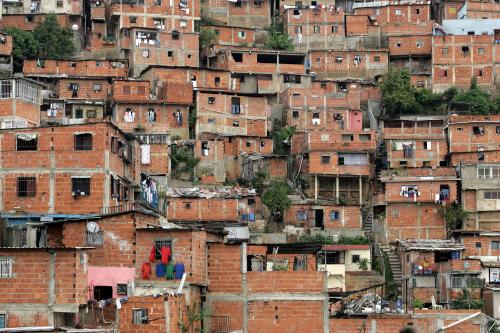
The film raises a further question. What is being defended is not just the interests of the United States but the interests of big companies and the rich. Early contrasts between luxurious mansions and the crumbling barrios set up an opposition between rich and poor which resonates through the film. An impicit question is asked: what happens when the natural resources and infrastructure of a nation are stolen from the nation as a whole and sold to rich people, many of whom live overseas. That is happening here too. Harold Macmillan, conservative peer and former Prime Minister was driven to accuse Margaret Thatcher of "selling off the family silver". That was in the early days of privatisation.

Here too the gap between rich and poor is widening, though it is nothing like as severe as in Latin America, with its dollar-billionaires and starving peasants. Most people will probably go on accepting the idea that things are as they must be, that power should lie with corporations rather than elected government, that democracy is somehow inextricable from the free market. But I don't accept it.

Suppose we protested against the sale of our resources and voted for a radical, nationalising government. Would we end up victims of U.S.-sponsored death squads? Would our singers suffer the fate of Chilean folk singer Victor Jara, whose hands were smashed to silence his guitar? He went on singing. U.S.-sponsored fascists beat him some more. Machine guns turned his flesh into corpse.

His songs and courage survive.


John Pilger's film The War on Democracy is on release in the United Kingdom - only in a few independent cinemas. The film will be distributed in New Zealand and Australia. So far as I can see, it is not being distributed in the United States.

Labels: , , , , , , , , , , , , , , ,

Sunday, July 08, 2007

"true allegiance"


posted by k

As a Brit, I find it slightly disturbing that children in the United States are expected to pledge allegiance to a gaudy piece of cloth. The pledge began with good intentions (the first version was written by a Christian Socialist). However, the idea of equality was omitted - apparently the text could only be agreed by making concessions to misogynists and racists.

The United States came into being with the Declaration of Independence, setting out the grounds on which a colony had the right to initiate revolution against a tyrannical ruler. It's still worth reading.

British subjects (Britain does not have citizens) can vote for qualified candidates for parliament. But MPs who don't believe in monarchy can't take their seats unless they're prepared to lie. Even the most moderate republican - someone who would do no more than vote for a republic if given the chance - is banned from taking a seat in parliament. Electors are allowed to vote for an honest republican but, should they do so, they will not be represented in parliament.

All new Members of Parliament and Members of the House of Lords are compelled to swear an oath of allegiance to the queen and her heirs.

A country which bars electors from choosing the representatives of their choice is not a democracy.

Gordon Brown has started a debate about constitutional reform.

The country may not be ready to become a republic. It may not be ready to debate the choice between a monarchy and a republic. But surely it's time to allow honest republicans to take their seats in the House of Commons.

There's a new petition on the Downing Street website. The text is simple and straightforward:

We the undersigned petition the Prime Minister to ensure that the Oath taken by Peers and MPs no longer pledges loyalty to the Monarchy.


You can sign the petition by clicking HERE.


Labels: , , , , , , , , , , , , , , , ,

Wednesday, June 06, 2007

National British Day: The Advance of Fascism

The Independent. Wednesday 6th June 2007. Deborah Orr: “Now they seek to micro-manage our lives in the name of patriotism and freedom. The idea of a National British Day sounds like a piece of idiocy that needs to be avoided at all costs.”

But this is more than idiocy. It is another resonant echo from the songsheet of instinctive Fascists. Those very people who would recoil in their distress at being described as having the instincts of the thug. For they are so reasonable whilst giving permission to the smiling and unsmiling thugs who in turn execute their policies and their warfare, who now define what our responsibilities must be in order for us to be granted the permission to exercise our rights. Ms Orr manages to complete her entire article without using the term “fascist”. Perhaps she is being cautious.

The clues to the underlying mindset of this government have been evident for some time. I recall my telling my MP in 1998 that it seemed to me that there had been some kind of coup. His expression at that time was somewhat quizzical. I recall that back in 2001, in the backwash of a major charitable regeneration endeavour and involvement in other community ventures, I was becoming increasingly frustrated by what I then perceived as the kidnap of Community and Charitable efforts by the Government to transform them into agents of policy (and Policing). At that time, in informal conversation at my home with the then Director Development of the Borough, I observed that we were seeing the development of "soft fascism". "That's an interesting perception" she said. At the time, it might have been interpreted as my growing cynicism. Perhaps I even hoped that was the case. That trend to fascism is now becoming more overt.

We have a culture of fear.
We have a growing emphasis on the health of the body.
We have the elevation of the corporate and the centralised above the rights and liberties of the individual (Fascism should more properly be called corporatism because it is the merger of state and corporate power." -- Benito Mussolini)
We have a National Curriculum for "Citizenship" (itself a misnomer since we are constitutional "subjects") and have diminished the range of education in history, in the range of literature and of broad context. (At the school where my partner works, the Head went through the library and instructed that ALL books over ten years old should be discarded).
We have illegal military intervention overseas.
We have the tolerance of the use of British Airports by Extraordinary Rendition flights managed by the US Govenment to ferry political prisoners to client states where the limitations on using psychological and physical torture which are extant within the US and Europe do not apply.

We have vast and increasing monitoring of the people as they go about their daily business. Where no-one is watching the watchers (Quis custodiet ipsos custodes?).
We have forms of "thought-crime" (harassment, distress, alarm and offensive T-shirts).
We have the means of imprisonment without trial.
We have the largest prison population in the European Community.
Protest has been disempowered and direct action (such as tree-hugging to disrupt road or runway construction) redefined as terrorism.
We have leaders who adhere to strange forms of religious faith and there is undue influence by certain groups of the "christian" right.
We have the demonisation of "immigrants" and, despite the surface appearance of efforts to the contrary, the demonisation of the Islamic peoples, whether or not born in the UK.
And the government, the media and the zeitgeist are focused on image rather than reason, which conceals the true nature of what is going on while dissenters or whistle- blowers are marginalised.
Meanwhile, in the area where I live, we had a BNP vote of over 20% in May.

We live in very dangerous times. One of the problems I now find is that in raising tangential issues, people don't know, won't understand or don't want to consider the implications of what you are talking about and will at times respond aggressively. For is this not Britain, a land of tolerance for the eccentric, a land of refuge for the displaced, a land where decent people muck in and muddle through, a land where you can express yourself without fear?

All myth now, I'm afraid.


Dodo (“>

Labels: , , , , , ,