"Know that we are still here; that we live."
posted by k
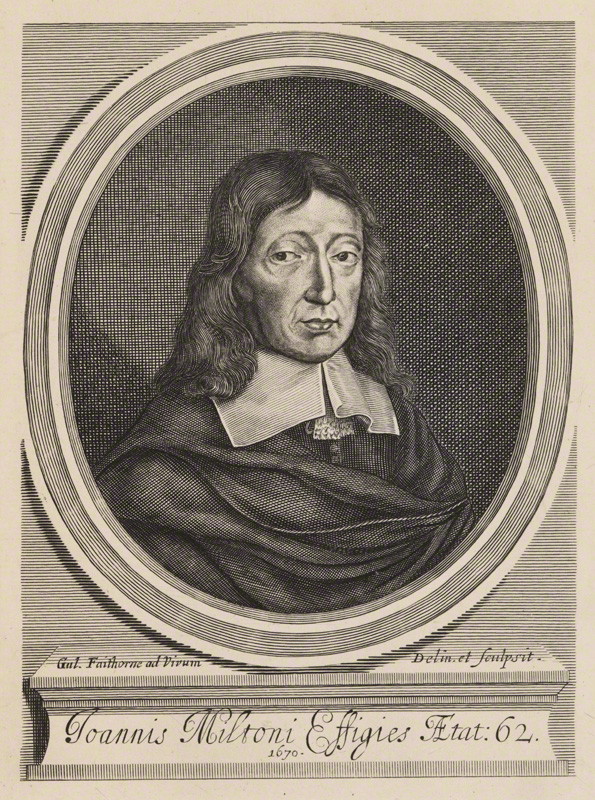
In 1660, the restored monarchy of England faced the problem of what to do with John Milton. Milton wasn't just an uncompromising republican, who had recently published the pamphlet The Ready and Easy Way to Establish a Free Commonwealth. He had also responded to the monarchist pamphlet, Eikon Basilike, with his own Eikonoklastes, defending the right of the Commonwealth government to execute Charles I. This made him, in the eyes of Charles II's government, a regicide and the penalty was death by hanging, drawing and quartering. The corpses of dead regicides were disinterred, executed and the decomposing quarters put on public display.
 Milton was discreet enough to retreat from London to Chalfont St Giles. It's said his friends and admirers intervened on his behalf, suggesting that his blindness was a divine punishment and that it would be wrong for the king to punish the poet further. The poet was allowed to live and completed his great works of the Restoration: Samson Agonistes, Paradise Lost and Paradise Regained.
States often have to cope with poets who oppose their regime. This isn't because poets are naturally in opposition - there's also a history of poets supporting the government with fawning praise. Virgil's praise of the Emperor Augustus is excellently done but leaves a nasty taste in the mouth. Shakespeare included neat compliments to the monarchs he served in his plays. He knew who paid the bills.
But the way states treat poets and creative artists who oppose them often goes down in history. Regimes that mistreat their poets seem particularly barbaric - afraid of words and their power. The voices of poets survive.

The Jerusalem Post knows it cannot ignore the death of the great Palestinian poet Mahmoud Darwish. Darwish's voice can still be heard - full of power even when I cannot understand the words. The words of his poems - in their original Arabic and in English translation - can be found in libraries throughout the world and on the web.
Mahmoud Darwish's funeral was also reported throughout the world.
 There is, currently, less publicity for the imprisonment and torture of Uzbek poet Yusuf Juma. Perhaps everyone is distracted by the Olympic Games or the news from Georgia. Or perhaps we're all so used to the atrocities of Karimov's regime that a tortured poet barely disturbs any more. But he will not be forgotten. Osip Mandelstam's poem against Stalin resonates more strongly because of Mandelstam's arrest, mistreatment and death.
I don't know what we can do about Yusuf Juma who is being held and tortured in Jaslyk prison. His son Mashrab seems to have disappeared in the Uzbek prison system. His wife is appealing for help.
At least, by posting this, I can show that Yusuf Juma is not forgotten. And I hope the Uzbek government will realise that, by imprisoning and torturing Yusuf Juma and his son, they add weight to the words Yusuf Juma has written against them.
I implore the Uzbek government to free the poet Yusuf Juma and his son.
Labels: dissidents, John Milton, Mahmoud Darwish, Palestine, poetry, prisoners, states, torture, Uzbekistan, Yusuf Juma
posted by areopagitica at 10:57 am
1 comments